
















The ALS Mineralogy Laboratory Manager will determine the appropriate measurement method to provide the liberation data to suit your purposes and budget. Normally, the measurement will be carried out on a sequence of closely sized fractions (although not necessarily contiguous size fractions) of your sample. The finest particles measured are 2 µm and the finest mineral inclusions are 0.5 µm.
MLA software and scanning electron microscope based technologies are combined to analyse mineral samples and produce solutions for exploration, mining, mineral processing and environmental industries. Analysis of samples produces high resolution images and statistically valid, quantitative mineralogical and textural data.
The report on CD-ROM contains:
- Colour mineral maps showing the distribution of minerals in all particles examined (typically 5,000 – 30,000).
- Software to view images and explore quantitative data;
- A database of quantitative mineralogical producing tables and graphs including:
- Mineral abundance and elemental deportment
- Particle and mineral size distributions
- Mineral liberation, locking and association
- Limiting grade-recovery curves
- Particle density distribution
Sample Requirements:
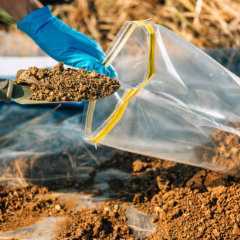
Requires 2-100 g of representatively split material in size fraction ranges of preferably no more than a factor of two between bottom size and top size, such as -150+75 µm. Size fractions extending to "0", such as -38 µm, are less preferred than those closed, such as -38+20 µm. Cyclosizer fractions are suitable. Cyclosizer tails and CS7 fractions are subject to a surcharge and often require desliming to allow successful preparation for the microscope.