













 Vyhledat
 čeština



























 Login
Login

Metallurgy experts at ALS are helping solve challenges at the forefront of the global energy transformation

If you asked 100 people to define metallurgy, it’s likely none would get it right. It even sounds mysterious – is it a pre-scientific approach to geology, akin to alchemy? Not quite. While alchemy arose from the dream of transforming common metals into gold, metallurgy is the less mystical and more practical scientific study of the properties of metals, and the development of processes for extracting them from the rock and sediment in which they are embedded.
“In the old days, mining companies would just blast the ore and feed it to the mill based on feed grade. They did their best, but there was no such thing as really understanding your deposit and being proactive,” explains Robert Sloan, Vice President of metallurgical services for the Americas for ALS – a global leader in the testing, inspection and certification (TIC) sector.
“Mining companies are more progressive now and invested in understanding the ore body in terms of its geology, mine-ability and metallurgical performance. We partner with them to provide the independent testing that informs their mining strategies.”
Among the projects studied by ALS’ global team of metallurgists, some of the most important involve helping transform the way energy is produced to reduce greenhouse gas emissions causing climate change. A wide variety of metals – from lithium, nickel, copper, aluminum and graphite to rare earth metals like neodymium, praseodymium, dysprosium, and terbium – is needed to supply the electric vehicle (EV) batteries and motors, charging stations, solar panels and wind turbines that will help lead the world to net-zero emissions (NZE) by 2050.
Energy transformation is critical to the health of the planet, but there is widespread concern that demand for energy sector metals could soon exceed supply, which will also increase costs. The 2024 International Energy Agency's (IEA) Global Critical Minerals Outlook 2024 report predicts that the combined market value of key energy transition minerals is set to increase by 80% in the NZE scenario. By 2040, the market value is estimated to more than double, reaching USD 770 billion. (1)
Metallurgical optimisation of metal extraction strategies, therefore, represents some of the most important and valuable work of this century.
“the new process is more environmentally friendly and has demonstrated production of a high-quality final product...”
Innovating cooler solutions for lithium
Helping to advance this progress, Robert and other leaders from ALS’ experienced metallurgy team recently shared an inside look at innovative research and development projects they’re conducting in collaboration with their clients in the metallurgy and mining industries to improve the output of energy-sector metals.
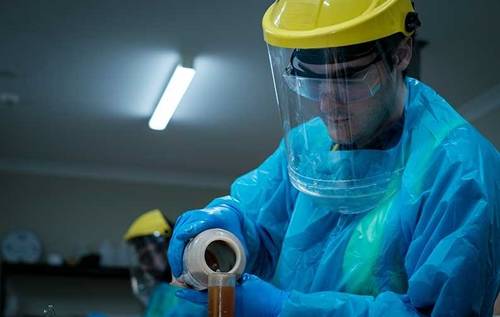
“We’ve seen what's proven to work and not to work, and we use this knowledge to drive innovative approaches to processing metals economically and in a more environmentally sound manner,” explains Matt Ameron, a senior metallurgist at ALS in Balcatta, Australia.
A key example of this innovation is the work Matt and his team are doing to develop a new method for extracting lithium from spodumene, the naturally occurring crystalline mineral rich in lithium, with deposits found throughout the world.
The traditional large-scale process for lithium extraction from spodumene involves a step called acid baking or roasting. Mined spodumene ore is first crushed, ground, concentrated, dried and then heated to about 1,050°C in an industrial kiln to convert refractory alpha-spodumene into more-reactive beta-spodumene form. The beta-spodumene is then mixed with concentrated sulfuric acid and heated again to around 250°C. This acid roasting step converts the lithium into water-soluble lithium sulfate, which can then undergo the leaching and purification processes that produce battery-grade lithium. (2)
“The acid bake technique works well on the bench,” Matt explains. “You can get great extraction, you can even make it work from a capital and operating expenditure point of view, but to make it work commercially is a major challenge.”
The drawbacks are significant: high energy consumption, environmental impact, technical and operational drawbacks, and high processing costs. Matt cites examples of lithium processing facilities that have struggled with the acid-baking process for years, producing lithium at about half of their operating capacity. The commercialisation challenge of this method has led to a global search for alternatives, one of which is being tested at ALS.
“An engineering firm we have a strong relationship with approached us with a concept for developing a new process to extract lithium from spodumene concentrates without the operating issues we’ve seen with acid baking,” Matt says.
“We’ve been testing this alternative method on a bench scale, where we’re seeing far less extraction of the contaminant elements that can complicate downstream refinement and slow down operation. And the technology involved in the new process aligns well with existing technologies where there is already a strong knowledgebase.”
Matt’s team has run the new method through several pilots and results are promising: the new process is more environmentally friendly and has demonstrated production of a high-quality final product even from low-grade lithium concentrates.
“This technology could be economically viable for commercial-scale lithium processing and production of battery-grade product within the countries where it is mined – not just Australia but also other spodumene-rich regions, for example in Africa and the Americas.”
ALS’ Principal Metallurgist in Australia, Jack Smith, agrees:
“This could be a real game changer. Based on the results we’re seeing, it has the potential to transform the industry in Australia and around the world for lithium from spodumene projects.”
While showing great promise toward more environmentally friendly lithium processing, it may take years before the new method can be implemented at a commercial scale – but the high demand for lithium and other critical energy sector minerals is already here and growing. That’s why ALS is helping industry partners with metallurgical research across all types of beneficiation – the broad category of processes used to improve the quality of raw ore.
One area of beneficiation research concerns the separation of lithium from waste rock before it can be optimised for battery-grade production. A key method for achieving this is known as dense media separation (DMS), a physical beneficiation method that uses media to separate particles based on their relative density.
Before DMS can be done at scale, it’s important to test and optimise, so ALS collaborated with an engineering firm that specializes in building minerals processing plants to successfully implement a new pilot-scale DMS plant at ALS’ main site in Balcatta. This advanced DMS pilot plant can simulate real-world DMS applications, enabling precise density-based particle separation.
“The installation and commissioning of the plant involved rigorous calibration and verification to ensure consistent, reliable results across diverse feed materials,” says Jack.
“The investment provides a critical capability to assess beneficiation processes,” he explains. “It complements our recent developments in classification and magnetic separation, especially relevant in the front-end processing of energy metals.”
Graphite matters
ALS is also researching more speculative innovations to help drive success in meeting energy-sector mineral demand – for example, testing a promising method for processing commercial-grade graphite that may offer a solution to a critical need in battery production.
Hailed as “the unsung hero of lithium-ion batteries”, graphite is the largest component of an EV battery pack by weight – each pack contains an average of 50 to 100 kilograms (110 to 220 pounds) of graphite – and there are currently no viable substitutes for it as the primary anode material. Its high energy density and conductivity contribute to quick charging, long driving ranges, and use in thermal management. (3)
Despite the importance of graphite in batteries, there is little widespread awareness of its role in transportation electrification – nor that the global supply of commercial-grade graphite may be insufficient to achieve NZE. Urgent efforts are needed to develop additional graphite projects in geographically diverse regions, and developing better graphite processing methods is a critical part of that need. (4)
”Processing graphite for commercial use is even more challenging than lithium,” Matt says. “The typical process includes subjecting graphite concentrate to a caustic bake or leaching with volatile hydrofluoric (HF) acid.”
“That’s why companies are trying to develop a non-HF and non-caustic bake process for more environmentally friendly, commercial-grade graphite,” Matt explains. “We’re currently working with an Australian company on a process using technology that has been proven in other applications. The latest pilot has gotten us close to the target specifications for battery grade graphite, but we’re not all the way there yet.”
Jack adds: “This one is an innovative development concept – a work in progress. We don’t know yet how well it will work, but if we're going to help meet the world’s energy transition target, then we need to be developing better graphite processes.”
“We can troubleshoot and provide timely feedback. … It’s like a medical test. You know what's wrong: you know the symptoms. We can help you understand what’s causing them.”
Diagnosing solutions
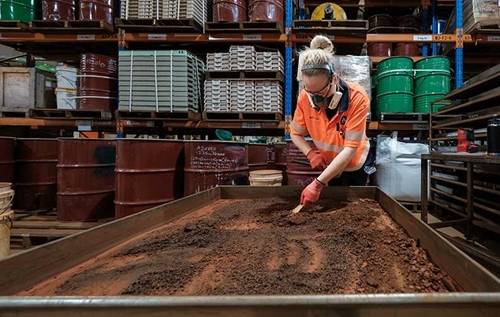
The effort to solve challenges at the forefront of mineral processing is part of what makes metallurgy unique in the materials science space. Robert Sloan likens the work of metallurgists to doctors diagnosing the health of mining projects:
“Because we have the cutting-edge minerology tools to analyse and understand the characteristics of our clients’ samples, we can troubleshoot and provide timely feedback,” Robert explains. “It’s like a medical test. You know what's wrong: you know the symptoms. We can help you understand what’s causing them.”
“This is what metallurgical engineers do,” he says. “Our job is to interpret the results and provide a report, like a doctor: This is your problem. This is our recommendation.”
Illustrating this analogy is ALS’ recommendation of an innovative method to address the “symptom” of the high cost of electricity required to grind minerals down to the fine sizes needed to achieve usable product.
According to Jack Smith, “If you can successfully grind a mineral down to a much coarser material and remove much of that from the process using coarse particle flotation technology, you can save on electricity costs by a considerable amount. Less electricity demand means using less fossil fuels and that can enable the introduction of more renewables into the process.”
“We've been running coarse particle flotation tests for quite a few projects in partnership with a leader in manufacturing that technology,” he adds. “We're excited about its potential positive impact on a project's sustainability.”
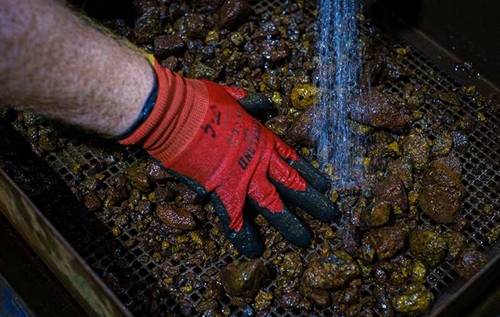
“Mining isn’t just digging something out of the ground and then commercializing it. There's a mystery about turning mined ore into something usable in the world.”
Quietly solving mysteries
At the dawn of the transformation of the global energy sector, perhaps metallurgy is on the verge of finally receiving greater recognition for its vital contribution to advancing our understanding of the minerals enabling progress – but whether or not they gain more of the spotlight, the passionately dedicated team of metallurgists at ALS will continue to investigate solutions to help its industry partners leverage Earth’s natural resources to power our world with more sustainable energy.
“Mining isn’t just digging something out of the ground and then commercializing it. There's a mystery about turning mined ore into something usable in the world,” Jack says. “For those of us involved in metallurgy, it’s endlessly interesting to unlock the mystery of an ore and help get something useful out of it.”
To find out more about ALS’ metallurgical solutions for ore processing, contact Jack Smith
ALS is a global leader in testing, providing comprehensive testing solutions to clients in a wide range of industries around the world. Using state-of-the-art technologies and innovative methodologies, our dedicated international teams deliver the highest-quality testing services and personalised solutions supported by local expertise. We help our clients leverage the power of data-driven insights for a safer and healthier world.
References
(1) https://www.iea.org/reports/global-critical-minerals-outlook-2024
(2) https://www.sciencedirect.com/science/article/pii/S2096519223008601
(3) https://aquametals.com/recyclopedia/why-is-graphite-so-important-to-lib/
(4) https://ecga.net/wp-content/uploads/2023/02/Graphite-in-batteries_Infosheet_final.pdf