
























 Search
 English



























 Login
Login


EnviroMail™ 083 Hong Kong
ELISA screening of cyanotoxins: enabling broad congener coverage for water monitoring

Cyanotoxins are a recognised risk in surface water systems used for drinking water supply. Produced by bloom‑forming cyanobacteria, these compounds require targeted monitoring to support public health protection. Recent updates to monitoring guidelines, including an expanded scope of cyanotoxin compounds in the Hong Kong Drinking Water Standards (HKDWS), have increased the focus on routine analytical assessment.
ALS provides reliable ELISA‑based screening for cyanotoxins, providing extensive congener coverage across key toxin groups, including microcystins and nodularins, cylindrospermopsins and saxitoxins. This capability supports routine monitoring programs by providing a practical screening tool for assessing overall toxin response.
Cyanobacteria and cyanotoxins in aquatic systems
Cyanobacteria (blue‑green algae) are a natural component of aquatic environments, including reservoirs, rivers and recreational waters. Under favourable conditions, such as elevated nutrient availability, warm temperatures and stable water columns, cyanobacterial populations can increase rapidly and form blooms.
While many cyanobacterial species are non‑toxic, some produce compounds known as cyanotoxins that can pose risks to human health, livestock and aquatic ecosystems (table 1).
Key toxin groups include:
- Microcystins – hepatotoxins commonly associated with Microcystis spp. (particularly Microcystis aeruginosa) in freshwater systems
- Cylindrospermopsins – cytotoxins produced by several freshwater cyanobacteria, most notably Raphidiopsis spp.
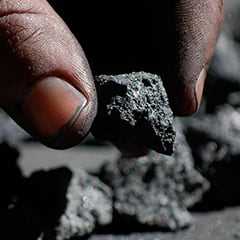
- Saxitoxins – neurotoxins associated with paralytic shellfish poisoning that can be produced by both cyanobacteria and marine dinoflagellates.
Toxin occurrence can vary significantly depending on species composition and environmental conditions. Importantly, the presence of cyanobacteria does not necessarily indicate toxin production, and toxin concentrations can increase rapidly as bloom conditions develop and evolve.
Table 1. Characteristics and health effects of regulated groups of cyanotoxins under the HKDWS; cylindrospermopsins, microcystins and saxitoxins.
| Cyanotoxin | Health risks | Common cyanobacteria producing the toxin | |
| Cylindrospermopsins | 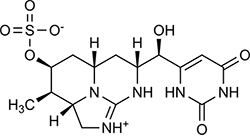 |
|
Raphidiopsis raciborskii Aphanizomenon flos-aquae Umezakia natans Chrysosporum ovalisporum |
| Microcystins | 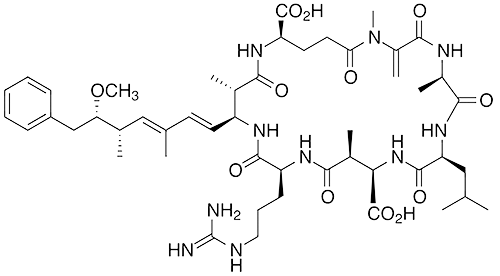 |
|
Microcystis spp. Dolichospermum spp. Planktothrix spp. |
| Saxitoxins | 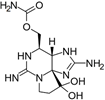 |
|
Aphanizomenon flos-aquae Aphanizomenon circinale Lyngbya wollei |
Monitoring cyanotoxins: context and requirements
In recognition of the risks posed by cyanobacterial blooms and associated toxins, the HKDWS have recently been updated to include additional cyanotoxin parameters. These changes strengthen the focus on cyanotoxins within the HKDWS and establish health-based limits for their presence in drinking water.
Cyanobacterial blooms in Hong Kong’s subtropical reservoirs can develop rapidly and change over short timescales, making conditions difficult to predict and requiring ongoing monitoring to track evolving risk. Observations of cyanobacterial presence and changes in community composition remain important for identifying bloom development and providing early indication of potential risk.
However, toxin concentrations do not always correlate with these changes, as toxic and non‑toxic strains may coexist and toxin production can vary independently of cyanobacterial abundance and environmental conditions. As a result, the presence of cyanobacteria does not necessarily indicate toxin risk, and reliance on cell‑based indicators may underestimate potential impacts.
This highlights the importance of targeted analytical assessment of cyanotoxins when risk factors, such as bloom events, affect vulnerable source waters. Effective monitoring therefore combines early awareness of bloom development with direct measurement of toxin concentrations as risk increases. ELISA screening enables direct measurement of cyanotoxins for assessment against HKDWS guidelines.
Screening approaches for cyanotoxins
Cyanotoxin monitoring in drinking water systems typically draws on multiple analytical approaches, each providing a different perspective on cyanobacterial presence, potential toxicity and realised risk. No single method provides a complete picture; used together, these approaches enable highly reliable assessment.
Microscopy and cell enumeration provide early indication of bloom development by identifying potentially toxigenic genera before critical intervention points. Molecular methods, such as qPCR, extend this early‑warning capability by detecting genes associated with toxin production. While both approaches are important in a risk‑management context, neither directly measures toxin presence or concentration.
In contrast, chemical analysis, such as ELISA and LC-MS/MS, provides direct measuremen of cyanotoxin compounds, enabling detection and quantification of target toxin groups. This supports assessment against HKDWS guideline values and provides a direct measure of toxins.
ELISA assay as a screening approach
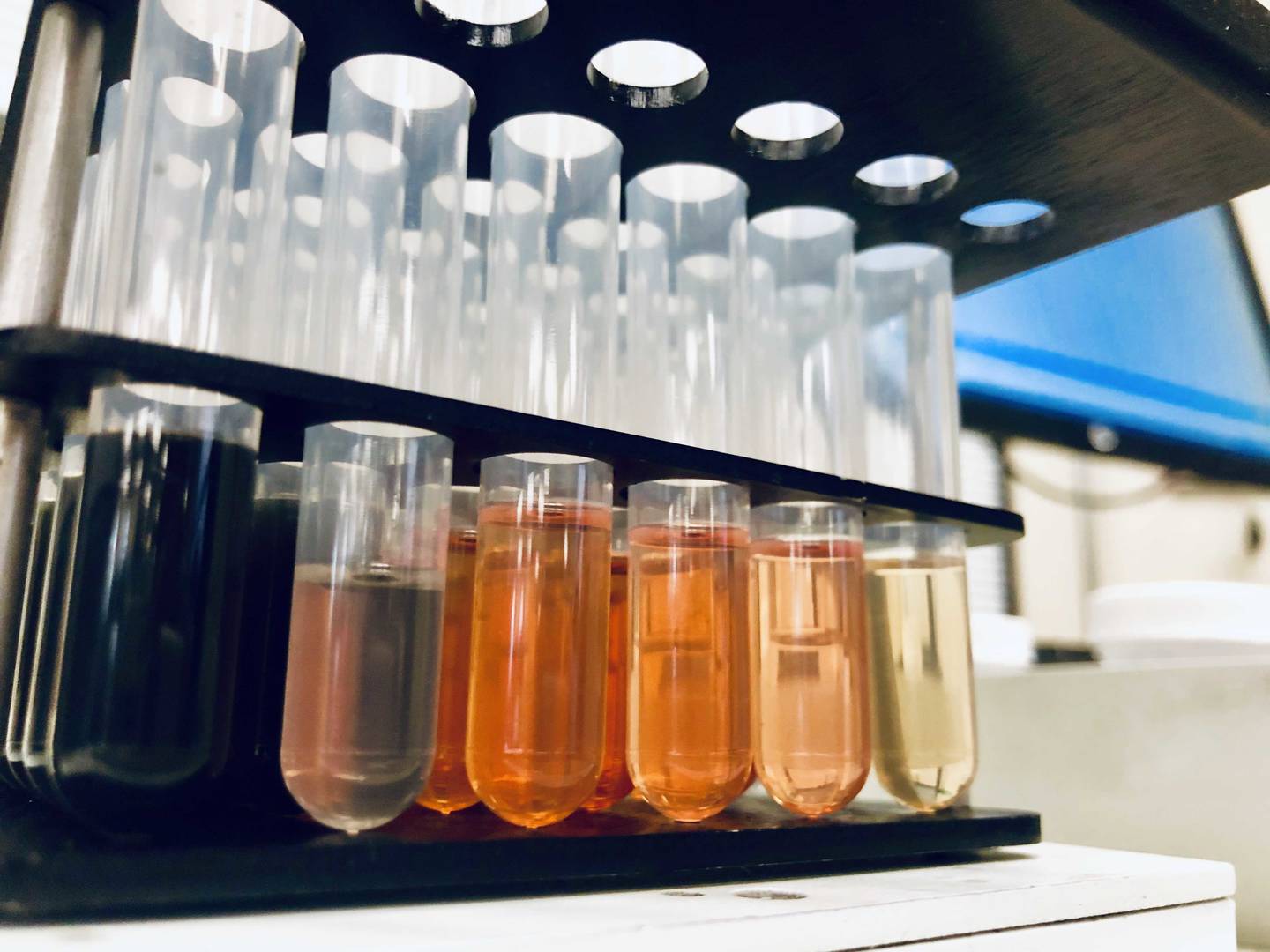
Enzyme‑linked immunosorbent assay (ELISA) enables cyanotoxin screening through antibody‑based detection, producing a colour signal inversely proportional to toxin concentration. The assays used by ALS employ competitive formats, where sample toxins compete with reference analogues for antibody binding.
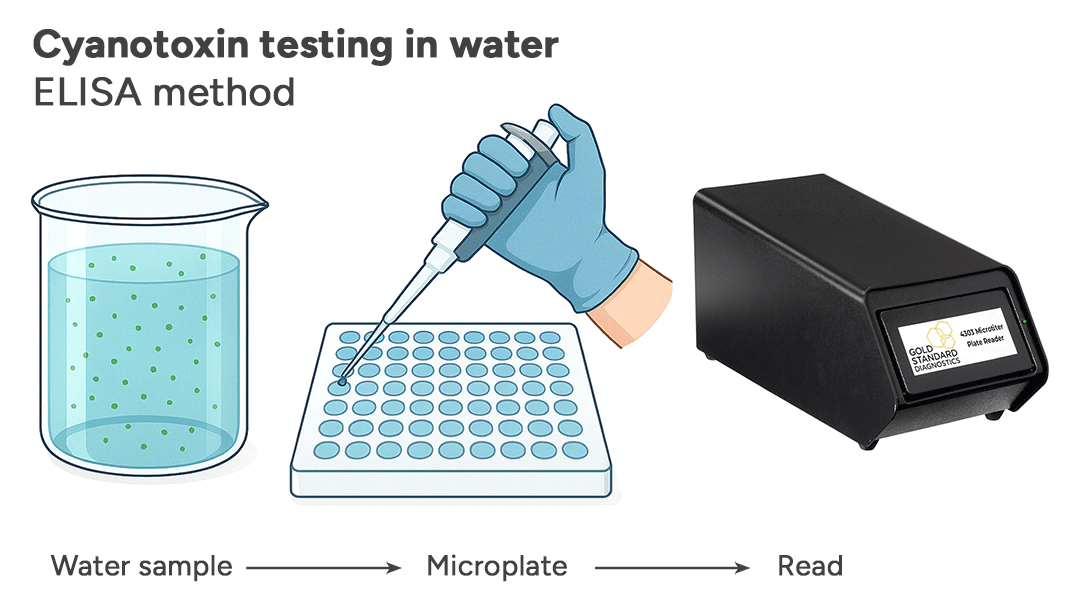
Lysed samples are added to a microplate containing immobilised antibodies, and the resulting signal is measured using an ELISA reader (figure 1). Results are reported as toxin equivalents rather than compound‑specific concentrations, reflecting the combined detection of multiple cross‑reacting congeners within each toxin group. Together with differences in antibody affinity between congeners, this means the assays provide a semi‑quantitative estimate of total toxin concentration.
Used as a screening tool, ELISA supports rapid identification of elevated concentrations and provides an indication of overall toxin response within a sample. Where required, elevated results can be confirmed using quantitative analytical methods.
Microcystins/nodularins (ADDA)
The microcystin/nodularin (ADDA) ELISA uses an indirect competitive assay based on antibody recognition of ADDA, a structural component common to microcystins and nodularins. This enables reliable detection across these structurally diverse toxin groups, with the measured response reflecting the total contribution of ADDA‑containing compounds.
As the assay targets a shared structural feature, it does not distinguish between individual congeners or between microcystins and nodularins. Instead, it provides a semi-quantitative indication of overall toxin burden suitable for screening applications.
Saxitoxins and cylindrospermopsins
The saxitoxin assay employs an antibody with broad cross‑reactivity to paralytic shellfish toxin congeners. This enables detection of multiple saxitoxin variants, including saxitoxin, neosaxitoxin, gonyautoxins and decarbamoyl analogues, with the measured response reflecting the combined contribution of these compounds.
In contrast, the cylindrospermopsins assay targets a smaller and less structurally diverse toxin group. It employs a more specific antibody to detect cylindrospermopsins and related analogues, providing a total response across this group.
Method overview
ALS offers ELISA‑based screening methods for cyanotoxins aligned with the HKDWS, supporting routine monitoring across key toxin groups.
The available methods target the principal regulated cyanotoxins, with coverage across structurally diverse compound groups while enabling efficient, high‑throughput screening with consistent, traceable data quality.
Reporting limits for each assay, together with the corresponding HKDWS guideline values, are summarised in Table 2.
| Regulated cyanotoxins | Drinking water limit (µg/L) | Method code | Assay target | ALS freshwater limit (µg/L) | ALS brackish / seawater limit (µg/L) |
| Microcystins | 1.0 | EME001 |
Microcystins / nodularins | 0.15 | 6.0 |
| Cylindrospermopsins | 0.7 | EME002 |
Cylindrospermopsins | 0.05 | 0.25 |
| Saxitoxins | 3.0 | EME003 |
Saxitoxins | 0.02 | 0.02 |
As a screening tool, ELISA provides rapid identification of cyanotoxin presence with extensive coverage across compound groups. Where elevated concentrations are detected, results can be confirmed using quantitative analytical techniques to support assessment against HKDWS guideline values.
Sampling considerations
To obtain representative and reliable results, careful attention is required during sample collection and handling, as cyanotoxin concentrations can change during storage and transport.
Appropriate glass containers should be used to minimise adsorption or degradation, with volume, preservation and holding time requirements varying according to the analyte. Samples should be stored under controlled temperature conditions, protected from light where required, and analysed within recommended holding times to minimise changes in cyanotoxin concentration.
For treated waters, samples must be quenched at the time of collection (eg with sodium thiosulfate) to neutralise residual disinfectants such as chlorine and prevent cyanotoxin degradation prior to analysis.
Careful sampling and handling are essential to ensure reported concentrations accurately reflect cyanotoxin levels at the time of collection. Table 3 summarises sample submission requirements and handling considerations for cyanotoxin analysis.
Table 3. Sample submission requirements and handling information
| Sample types | Several water matrices including raw water, treated water, sea water and brackish water |
| Turnaround time | Express service: 5 working days Normal service: 10 working days |
| Holding time | Refrigerated (4±2°C): ≤5 days Frozen (-20±5°C): ≤14 days |
| Sample container |
Cylindrospermopsins and Microcystins:
Saxitoxins:
|
Contact your ALS project manager today for more information about screening for cyanotoxins by ELISA.