



























General ore characterisation and beneficiation

Iron ore characterisation & beneficiation (Gravity, DMS, Jigging, UCC, Cyclones)

Whether it be for hematite, magnetite or other ore types, characterisation and beneficiation by particle size and SG often plays and important part in producing a saleable grade product for metal production. At the Iron Ore Technical Centre (IOTC) in Wangara, Western Australia, ALS has an extensive range of beneficiation options to suit a variety of processing scenarios.
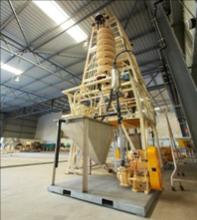
fábricas com torres helicoidais de minério de ferro

Beneficiation testwork services at the IOTC

Beneficiation by size and SG employs a variety of different equipment types. ALS offers the following from the IOTC:

  • Screening by size: ALS has multiple vibratory screening units to process sample lots as wet or dry batches or as unit processes in pilot plants. Two “screenability” units are available to assess the efficiency of selected screen/mesh panels relative to material characteristics.
  • Gravity separation: Options at the IOTC are as follows:
    • Spiral tower: ALS has a dedicated spiral rig set-up at the Iron Ore Technical Centre (IOTC) for spiral specific optimisation testwork. The rig holds four spirals and can be configured for rougher and cleaner circuits. ALS does not keep a large inventory of spirals, but rather fosters good operating alliances with the major spiral manufacturers (e.g. Mineral Deposits, Multotec and Alicoco) to borrow various spirals to suit the testwork program.
    • Wilfley shaking table. The IOTC holds a Wilfley 800 (1/8th size #13, 0.8 m2 – 640 x 1280 mm). Additional Wilfley tables are also available from Balcatta and Tasmania if more complex tabling processing is required.

  • DMS (Dense Media Separation): Use of DMS (i.e. a slurry of fine ferrosilicon particles) is routinely practiced for the separation of hematite lump and fines particles. DMS is a very robust and predictable process also well suited to rejection of lower grade or gangue material based on SG.
    • Erickson cone: Suitable for batch samples 10-40 kg.
    • DMS cyclone rig: This fully continuous rig inclusive of feed and product screening has two cyclones installed (150 mm and 50 mm).
  • Jigging: ALS has a both the small bench scale Alflux jigging apparatus for smaller samples in the range of 20-100 kg. Also housed at the IOTC is a large pilot scale proprietary Allflux continuous pilot jig suitable for feeds up to 1 tph.
  • UCC (Up-Current Classification: The principles of Stokes Law are also extremely robust and predictable for separation by SG certain ore types at particles sizes above 50 µm. UCC options at the IOTC are as follows:
    • Proprietary almineral upcurrent classifier. Suitable for sample masses of 20 kg to 100 kg.
    • Traditional cylindrical UCC (custom rig): Suitable for small sample masses <10 kg and also finer size distributions down to 20 µm.
  • Large scale hydro-cyclone testing rig: In 2022, ALS has completed the construction of a large-scale hydro-cyclone testing rig. This industrial sized tower is equipped with 2 x 6/4 Keto AH Centrifugal slurry pumps feeding a hydro-cyclone installation (typically 6, 8, or 10-inch cyclone units). Installed on both the overflow and underflow streams are two Multotec programmable rotary samplers capable of accurately cutting representative samples from high slurry flowrates. This facility is ideal for testing of various sizes, types and brands of hydro-cyclone relative to material characteristics.

Other related services

Beneficiation often occurs in conjunction with Sample Preparation or Gold testing and magnetic separation testwork.

Don't quite see what you're looking for or need more information?

Beneficiation options are manifold and selecting the best process for your ore can be daunting. ALS has the experience and capability to assist you in this area of testing.

Please contact us for further details.

Here are some frequently asked questions

  • How much mass do I need for a beneficiation program?

    This will depend on the scope of work and downstream and product requirements. Sample masses can range from a few kilos to ~10 tonnes. Typical masses and throughputs are given in our beneficiation page.

  • Our samples are from overseas, what do I do?

    ALS is a quarantine approved premises and treats many samples of oversea origin. Strict regulatory requirements are in needed around packaging and paperwork, however. ALS can advise you on these requirements.

  • Can my associates and I view the testwork at ALS’s laboratory?

    Yes, clients are always welcome to visit our facilities and observe samples or tests in progress. Inductions are required and other rules may apply to visitors.

  • Will ALS dispatch my samples to third parties?

    Yes, if a testwork program is in progress, ALS will happily dispatch testwork products and feed samples to vendors, third party laboratories, and customers as required. Fees apply.

  • Does ALS do design engineering and consulting?

    No, as it is not our core business and would put us in direct competition with many of our clients. In the case of HPGR testwork programs, KMA as equipment suppliers, provide engineering and consultancy for their industrial units and can provide relevant information for the manufacture and supply of appropriate Koeppern HPGR units.

Associated testwork services

Related testwork

Beneficiation often occurs in conjunction with:

Click on the above links or contact us for further information. We can integrate a full program for you if required.