




























 Login



EnviroMail™ 77
Canada
EnviroMail™ 77
Testing airborne and particle-bound PFAS with OTM-45
ALS now offers advanced PFAS air testing services to support compliance and risk assessment.

ALS recently completed validation of an analytical method for the measurement of vapour-phase and particulate-bound PFAS in air by the US Environmental Protection Agency’s Other Test Method 45 (US EPA OTM-45). OTM-45 PFAS testing is now available to our Canadian clients to support better understanding of PFAS air emissions and emerging regulations around waste incineration.
Volatile and semi-volatile PFAS air testing methods
Introduced in 2021, the OTM-45 method was originally developed for the North American market to better characterize PFAS air emissions – a previously underexplored pathway.1 Despite these advances, the extent of airborne PFAS contamination remains an under-characterized environmental pathway in Canada.
OTM-45 is often applied alongside EPA’s Other Test Method 50 (OTM-50), introduced in 2024. The two methods were designed to capture different categories of PFAS from air emissions.
OTM-50 focuses on volatile PFAS in gas form2, while OTM-45 captures semi-volatile PFAS across both particulate and gaseous phases, with particular focus on PFAS emitted from stationary-source high-temperature processes. OTM-50 uses passivated stainless steel canister sampling, while OTM-45 adapts sampling trains from EPA’s Hazardous Waste Test Methods (SW-846) to isokinetically sample air and gas from stationary gas emissions. Used together, they can provide a comprehensive and complementary understanding of airborne PFAS emissions.
Both methods are now available to ALS clients in Canada. OTM-45 testing is conducted at the ALS laboratory in Melbourne, Australia. OTM-50 testing is available in Canada at ALS Waterloo. Any ALS location in Canada can coordinate sampling supplies, sample receipt, and shipping logistics for both tests.
Environmental sources and transmission
As understanding of PFAS mass flux deepens, regulatory and industry focuses are shifting towards airborne emissions as a potentially significant source of environmental contamination, driving the need for more advanced sampling methods.
Gas phase and particle phase PFAS may be emitted into the environment through a range of sources. Emissions from industrial processes, manufacturing facilities, weathering of PFAS-containing materials, and combustion or incineration of PFAS have all been identified as potential vectors of airborne PFAS spread. Once emitted, PFAS can travel significant distances, with detections reported in remote regions such as Antarctica3 and other areas with no known PFAS industries, highlighting the role of air as a key transport pathway.
PFAS have been shown to remain at the air-water interface due to their hydrophobic fluorocarbon backbone and polar head functional groups.4 This causes partitioning between gas and water phases, contributing to PFAS mobility through gas or particulate matter. Short-chain PFAS are generally more water soluble and more likely partition to aqueous aerosols, while less soluble longer-chain PFAS tend to partition onto surfaces of airborne particles.4
Once airborne, atmospheric movement shifts PFAS, sometimes thousands of kilometres from their original source. A mixture of wet and dry deposition within the atmosphere then precipitates PFAS back into the environment.
Regulatory drivers of PFAS air testing
International governments and regulatory bodies have started to identify air as a vector for PFAS movement in the environment, shaping regional responses to air emissions monitoring. Thermal treatment and desorption facilities can be a major source of PFAS, due to their handling of highly contaminated materials. While most facilities are required to conduct mass balances to account for PFAS losses, these may not capture all PFAS species or account for all loss routes.
The European Union is a key example of government agencies initiating testing mandates for airborne PFAS. Working under Directive 2010/75/EU on Industrial Emissions,5 better known as the Industrial Emissions Directive (IED), the EU aims to reduce industrial emissions throughout EU member states to safe levels by 2050, with PFAS as a key emission focus. The US EPA is similarly working towards a technical foundation in regulating PFAS in air, with violating polluters sanctioned and fined for environmentally-contaminating air emissions.
In Canada, federal assessment and management of PFAS continues to evolve, including consideration of releases to air. Environment and Climate Change Canada has identified air as a potential PFAS release and transport pathway.
OTM-45 and OTM-50 are currently the best available test methods to support industry with high quality and reliable testing for PFAS in air.
Sampling methodology and holding times
OTM-45 analysis uses a sampling train adapted from US SW-846 Test Method 0010: Modified Method 5, with the removal of potential PFAS contamination sources as a key modification. Air sampling pumps are set to withdraw samples from an air or gas flow, utilizing a probe with glass fiber or quartz filter. Air flow is then condensed and deposited through XAD-2 resin, a polymeric adsorbent provided by ALS. Air flow then continues through a series of impinger solutions before passing through a final XAD-2 resin breakthrough trap.
The full sampling train generates a series of seven different samples, which are combined into four parts for final extraction, with analysis by liquid chromatography with tandem mass spectrometry (LC-MS/MS).
For quality control, isotopically labelled PFAS reference standards are fortified by the lab onto the first XAD-2 resin tube. Four individual results are generated, and a sum is calculated across all extracts as a recovery check.
The OTM-45 method reports PFAS compound amounts as nanograms per fraction, providing an accessible and practical format for environmental consultants, project assessors, and industry decision-makers working with PFAS in air. For a list of the 55 PFAS available for analysis and their limits of reporting (LORs), please refer to Table 1.
Sampling train rinses, particulate filters, impinger solutions, and XAD-2 resin samples must be submitted to an ALS facility in Canada within 7 days of sampling to ensure that samples can be extracted within the 28 day hold time.
Please refer to the OTM-45 method for detailed sampling guidance. Collected samples should be stored and transported at 4°C, with the exception of particulate samples, which should be unrefrigerated and stored in a separate container. All samples should be protected from UV light.
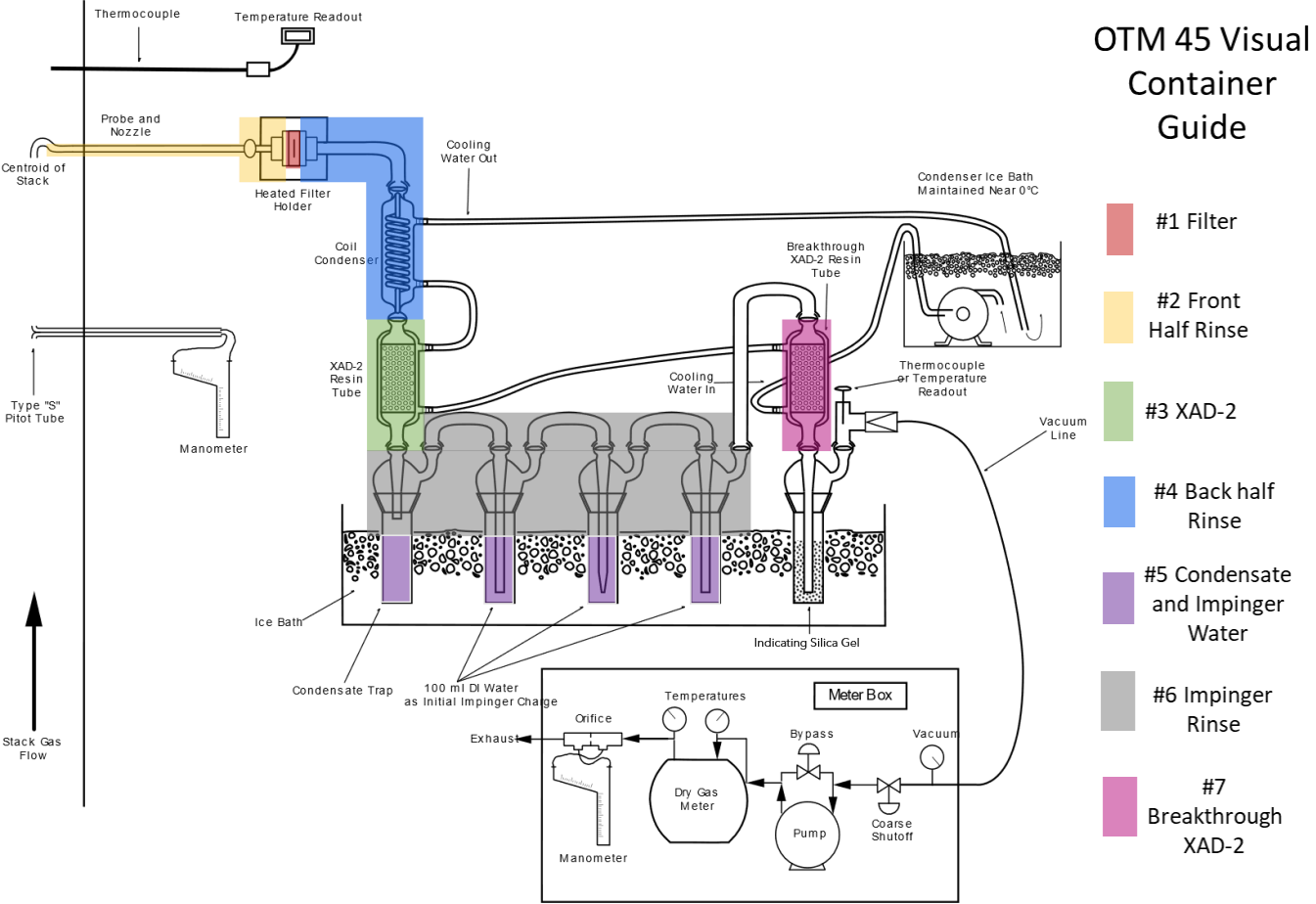
Figure 1. OTM-45 sampling train.1
Expert PFAS testing with ALS
ALS is a global leader in PFAS testing, with extensive experience supporting complex PFAS investigations and remediation projects.
As regulatory requirements and project needs evolve, we’re committed to an expanding scope of testing services, with OTM-45 as the latest addition to our capabilities.
Please contact your local ALS Project Manager for more information about OTM-45 or OTM-50 sampling supplies, logistics and analysis.
Table 1
| Compound | CAS number | LOR (ng) |
|---|---|---|
| Perfluoropropane sulfonic acid (PFPrS) | 359868-82-9 | 0.5 |
| Perfluorobutane sulfonic acid (PFBS) | 375-73-5 | 0.5 |
| Perfluoropentane sulfonic acid (PFPeS) | 2706-91-4 | 0.5 |
| Perfluorohexane sulfonic acid (PFHxS) | 355-46-4 | 0.5 |
| Perfluoroheptane sulfonic acid (PFHpS) | 375-92-8 | 0.5 |
| Perfluorooctane sulfonic acid (PFOS) | 1763-23-1 | 0.5 |
| Perfluorononane sulfonic acid (PFNS) | 68259-12-1 | 0.5 |
| Perfluorodecane sulfonic acid (PFDS) | 335-77-3 | 0.5 |
| Perfluorododecane sulfonic acid (PFDoDS) | 79780-39-5 | 0.5 |
| Perfluoro-4-ethylcyclohexanesulfonic acid (PFECHS) | 335-24-0 | 0.5 |
| Perfluorobutanoic acid (PFBA) | 375-22-4 | 0.5 |
| Perfluoropentanoic acid (PFPeA) | 2706-90-3 | 0.5 |
| Perfluorohexanoic acid (PFHxA) | 307-24-4 | 0.5 |
| Perfluoroheptanoic acid (PFHpA) | 375-85-9 | 0.5 |
| Perfluorooctanoic acid (PFOA) | 335-67-1 | 0.5 |
| Perfluorononanoic acid (PFNA) | 375-95-1 | 0.5 |
| Perfluorodecanoic acid (PFDA) | 335-76-2 | 0.5 |
| Perfluoroundecanoic acid (PFUnDA) | 2058-94-8 | 0.5 |
| Perfluorododecanoic acid (PFDoDA) | 307-55-1 | 0.5 |
| Perfluorotridecanoic acid (PFTrDA) | 72629-94-8 | 0.5 |
| Perfluorotetradecanoic acid (PFTeDA) | 376-06-7 | 0.5 |
| Perfluorohexadecanoic acid (PFHxDA) | 67905-19-5 | 0.5 |
| Perfluorooctadecanoic acid (PFODA) | 16517-11-6 | 0.5 |
| Perfluorooctane sulfonamide (FOSA) | 754-91-6 | 0.5 |
| N-Methyl perfluorooctane sulfonamide (MeFOSA) | 31506-32-8 | 1.25 |
| N-Ethyl perfluorooctane sulfonamide (EtFOSA) | 4151-50-2 | 1.25 |
| N-Methyl perfluorooctane sulfonamidoethanol (MeFOSE) | 24448-09-7 | 1.25 |
| N-Ethyl perfluorooctane sulfonamidoethanol (EtFOSE) | 1691-99-2 | 1.25 |
| N-Methyl perfluorooctane sulfonamidoacetic acid (MeFOSAA) | 2355-31-9 | 0.5 |
| N-Ethyl perfluorooctane sulfonamidoacetic acid (EtFOSAA) | 2991-50-6 | 0.5 |
| 4:2 Fluorotelomer sulfonic acid (4:2 FTS) | 757124-72-4 | 0.5 |
| 6:2 Fluorotelomer sulfonic acid (6:2 FTS) | 27619-97-2 | 0.5 |
| 8:2 Fluorotelomer sulfonic acid (8:2 FTS) | 39108-34-4 | 0.5 |
| 10:2 Fluorotelomer sulfonic acid (10:2 FTS) | 120226-60-0 | 0.5 |
| Perfluoro(2-ethoxyethane) sulfonic acid (PFEESA) | 117205-07-9 | 0.5 |
| 9-Chlorohexadecafluoro-3-oxanonane-1-sulfonic acid (9ClPF-3ONS) | 73606-19-6 | 0.5 |
| 11-Chloroeicosafluoro-3-oxaundecane-1-sulfonic acid (11Cl-PF3OUdS) | 83329-89-9 | 0.5 |
| HFPO-DA / GenX | 13252-13-6 | 0.5 |
| Perfluoro-4-methoxybutanoic acid (PFMBA) | 863090-89-5 | 0.5 |
| Perfluoro-3-methoxypropanoic acid (PFMPA) | 377-73-1 | 0.5 |
| Nonafluoro-3,6-dioxaheptanoic acid (NFDHA) | 151772-58-6 | 0.5 |
| ADONA | 2250081-67-3 | 0.5 |
| 3:3 FTCA | 356-02-5 | 0.5 |
| 5:3 FTCA | 914637-49-3 | 0.5 |
| 7:3 FTCA | 812-70-4 | 0.5 |
| 6:2 FTCA / FHEA | 53826-12-3 | 1.25 |
| 8:2 FTCA / FOEA | 27854-31-5 | 1.25 |
| 10:2 FTCA / FDEA | 53826-13-4 | 1.25 |
| 6:2 FTUCA / FHUEA | 70887-88-6 | 0.5 |
| 8:2 FTUCA / FOUEA | 70887-84-2 | 0.5 |
| 10:2 FTUCA / FDUEA | 70887-94-4 | 0.5 |
| 6:2 Fluorotelomer sulfonamide alkylbetaine (6:2FTAB) | 34455-29-3 | 0.5 |
| 6:2 diPAP | 57677-95-9 | 1.25 |
| 8:2 diPAP | 678-41-1 | 1.25 |
| 6:2 / 8:2 diPAP | 943913-15-3 | 1.25 |
References
1 United States Environmental Protection Agency (US EPA), Other Test Method 45 (OTM-45) Measurement of Selected Per- and Polyfluorinated Alkyl Substances from Stationary Sources, 14 January 2025, accessed 27 October 2026, www.epa.gov/system/files/documents/2025-01/other-test-method-45-rev1-final-1-14-25.pdf.
2 United States Environmental Protection Agency (US EPA), Other Test Method 50 (OTM-50) Sampling and Analysis of Volatile Fluorinated Compounds from Stationary Sources Using Passivated Stainless-Steel Canisters, 14 January 2025, accessed 27 October 2026, www.epa.gov/system/files/documents/2025-01/otm-50-release-1-r1.pdf.
3 P Casal, Y Zhang, JW Martin, M Pizarro, B Jimenez & J Dachs, Role of Snow Deposition of Perfluoroalkylated Substances at Coastal Livingston Island (Maritime Antarctica), Environmental Science & Technology, volume 51(15), 2017, pp 8460–8470, doi.org/10.1021/acs.est.7b0252.
4 AC Lemay & IC Bourg, Interactions Between Per- and Polyfluoroalkyl substances (PFAS) at the Water-Air Interface, Environmental Science & Technology, volume 59(4), 2025, pp 2201–2210, doi.org/10.1021/acs.est.4c08285.
5 European Union, Document 32010L0075: Directive 2010/75/EU of the European Parliament and of the Council of 24 November 2010 on industrial emissions (integrated pollution prevention and control), 24 November 2010, accessed 27 October 2026, eur-lex.europa.eu/eli/dir/2010/75/oj/eng.
Download this EnviroMail - EnviroMail 77 Testing airborne and particle-bound PFAS with OTM-45

Extended PFAS Analyte Reporting and Trace-Level Testing by EPA Method 1633A
ALS now offers trace-level testing for up to 60 Per- and Polyfluoroalkyl Substances (PFAS) in surface water, groundwater, soil, sediment, and biosolids by US EPA Method 1633A; expanding the standard 40-analyte suite by an additional 20 compounds.
Learn More about Extended PFAS Analyte Reporting and Trace-Level Testing by EPA Method 1633A