






























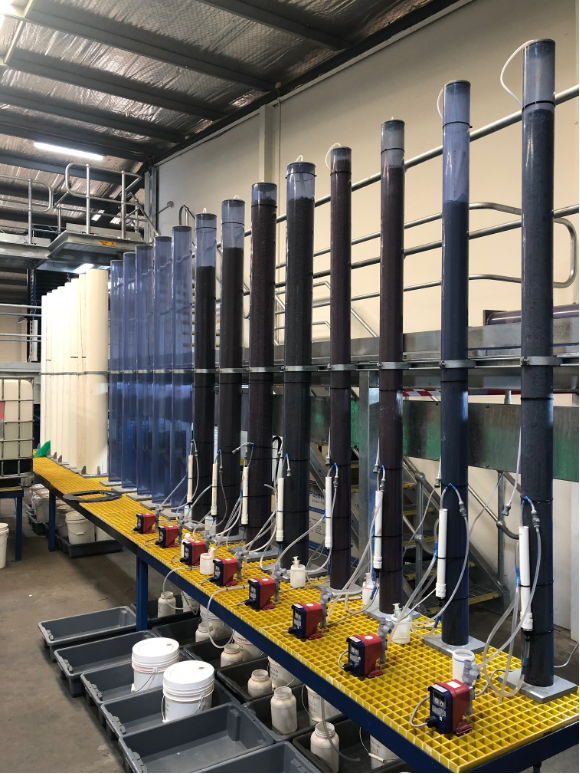
Huge multi column facility

Dump and heap leaching (via irrigation and percolation of cyanide onto and through the material) is often the selected process option for many marginal low-grade orebodies or pre-existing waste/tailings dumps. In 2021 ALS has expanded into a new bespoke column leaching facility that offers a full range of heap and dump leaching services, covering basic scoping tests through to feasibility studies on larger scale continuous columns.
lixiviação em monte

Heap leaching testwork services

In place of heaps and dumps, laboratory testing is ultimately conducted in columns of various sizes. Column leaching using cyanide solution to assess heap-leaching potential of gold bearing ores usually follows the following processes:

  • Agglomeration testing. After sample preparation and crushing to the target crush size, samples destined for column testing will very often require agglomeration testing. This includes assessment of moisture and binder additions (cement and/or lime) required to produce suitable agglomerates, as appropriate, to enable the cyanide solution to percolate through the column (heap) to be collected via the impermeable base layer. Agglomeration is performed in a modified cement mixer suitably sized for sample charges of 3kg to 15kg.
  • Percolation testing. Agglomerated batches are tested in small scale columns to assess the degree of solution percolation through the sample mass and the flow characteristics (i.e. laminar or tunneling). The correct moisture level is critical to achieving competent agglomerates. Cement additions should provide agglomerates with sufficient strength to ensure integrity is largely retained under flooded conditions resulting in adequate percolation rate and minimal slump in the small-scale test. The test should also result in drain solution pH in the approximate range of 9.5 to 11.5 such that the ore’s alkalinity demand is sufficiently met. The empirical test outcomes considered suitable in the small-scale tests are: <10% slump and >10,000 L/m2/hr drain rate.
  • Small scale column testing. The new facility now allows for a large number of column tests, of varying dimensions, to be operated concurrently. The multi-level platform allows easy and safe access to the top of all columns. Each leach column is equipped with a matched carbon column for removal of gold / silver from rich solutions and the recycle of the spent solution. Dosing pumps are fitted with quick-connect fittings allowing single pump operation to deliver solution to ore and carbon columns. All columns have spill trays located beneath to safely contain solution in the event of spillage. All tests are monitored daily for solution volume and subsamples collected for pH and free cyanide determinations as well as metals analysis. Where possible columns are fabricated from clear PVC to allow visual assessment of agglomerate structure and integrity.
  • Larger scale column testing. Similar to the small-scale columns, larger scale columns can be fabricated to suit the program requirements and run in the same manner.
  • Ancillary carbon adsorption testing
  • Determination of performance and auxiliary parameters.

An important consideration in laboratory test programs is that the prepared samples have a size distribution that approximates a commercial crushing plant output for the desired top-size. This may require appropriate adjustment of the primary crushed product to avoid a disproportionate distribution in the coarse-end sizing.

ALS has also conducted sequential column tests whereby leach solution from one column is used to irrigate a second column in series. Loaded leach solutions can be passed through activated carbon columns and the regenerated cyanide solution recycled.

Don't quite see what you're looking for or need more information?

ALS understands that every gold program needs a tailored testing flowsheet specific to the ore.

Please contact us for further details.

Here are some frequently asked questions

  • Will ALS treat hazardous samples?

    Generally, yes. ALS has facilities and procedures to treat fibrous and radioactive samples. Surcharges do apply, however, to cover safety equipment, monitoring and decontamination.

  • Our samples are from overseas, what do I do?

    ALS is a quarantine approved premises and treats many samples of oversea origin.  Strict regulatory requirements are in needed around packaging and paperwork, however.  ALS can advise you on these requirements. 

  • Can I do my own testwork in ALS's laboratory?

    Generally, no. Insurance and safety protocols typically prevent renting laboratory space and this is not part of ALS’s business model. Clients are able to visit and witness testwork but this is to observe only. Typically, clients may attend on 24/7 piloting campaigns and interact with senior staff members for technical and operational issues.

  • Does ALS do design engineering and consulting?

    No, as it is not our core business and would put us in direct competition with many of our clients. We can, however, put you in contact with a range of reputable engineering providers and consultants.

Associated testwork services

Related testwork

Gold ores and the associated free milling metallurgical testwork results very often don’t fit into nice categories and packages and will often require other testwork, such as:

Click on the above links or contact us for further information. We can integrate a full program for you if required.