
 Search
 English



























EnviroMail™ 169 Australia & New Zealand
Trace-level adsorbable and extractable organic fluorine for PFAS monitoring
ALS now offers precise, low-level adsorbable organic fluorine (AOF) and extractable organic fluorine (EOF) analysis for water, soils and solids matrices to support PFAS investigations across Australia and New Zealand.

The increasing number and diversity of per- and polyfluoroalkyl substances (PFAS) continue to challenge water quality monitoring and environmental assessment programs, particularly at sites with complex or poorly characterised sources.
Standard PFAS methods quantify a defined list of targeted compounds, with less than 40 standard US EPA analytes offered across most commercial analytical laboratories. Extended suites, such as those available at ALS, may offer up to 70 compounds out of a potential seven million. However, complex matrices may contain a broader range of PFAS, precursors and other fluorinated organic compounds not captured by targeted analysis.
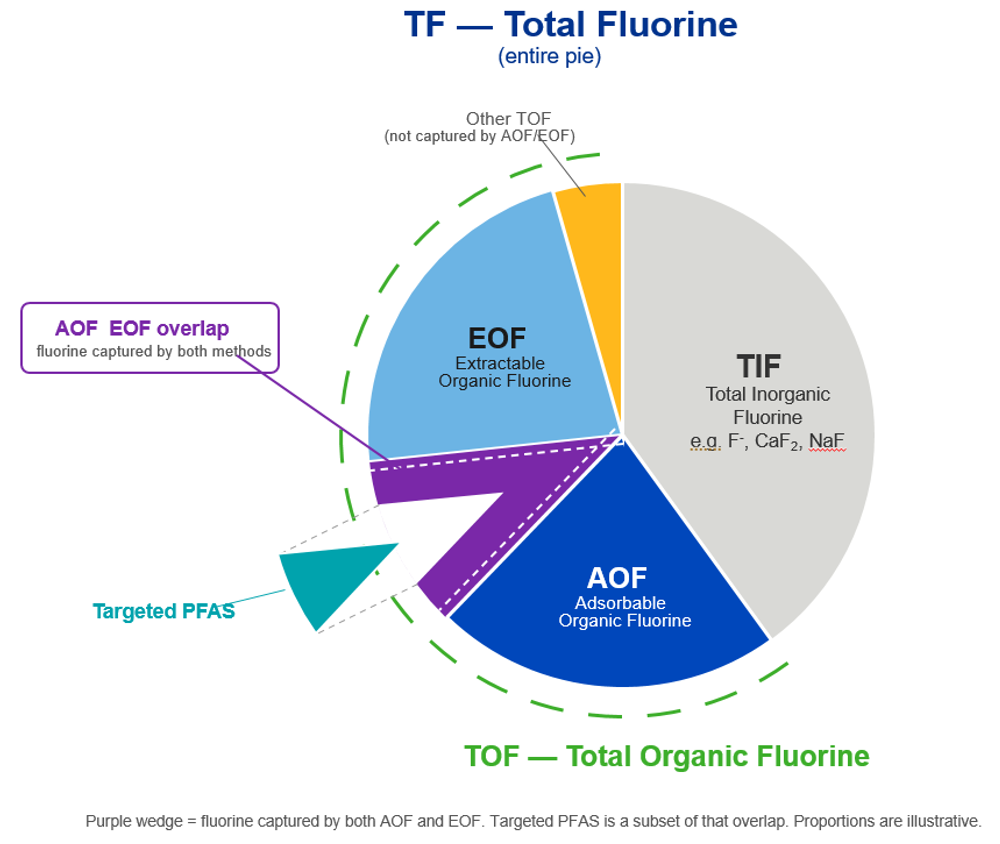
In these contexts, targeted PFAS results may therefore account for only a proportion of the organic fluorine present in samples affected by complex sources. AOF and EOF analysis helps address this gap by measuring a wider range of operationally defined fractions of organic fluorine – including target and non-target PFAS, as well as non-PFAS fluorinated organic compounds – supporting more comprehensive characterisation and risk-based environmental decision-making.
Our AOF and EOF analyses provides limits of reporting among the lowest available in global commercial laboratories, at 0.5 µg F/L for water and 0.2 mg/kg for soils and solids. This exceptional precision benefits industry experts seeking to identify PFAS trends in water quality monitoring.
Both services are available to request through ALS sites across Australia and New Zealand, with testing exclusively done at our Ontario, Canada laboratory.
AOF, EOF and total organic fluorine (TOF)
AOF and EOF are complementary approaches for measuring broader fractions of organic fluorine, defined by its distinct, operationally defined sample preparation techniques used to isolate the organic fluorine fraction prior to combustion ion chromatography (CIC).
For AOF, organofluorine compounds are adsorbed onto granular activated carbon (GAC). US EPA Method 1621, Determination of Adsorbable Organic Fluorine in Aqueous Matrices by Combustion Ion Chromatography, measures organofluorine compounds from PFAS and non-PFAS fluorinated compounds, including some pesticides and pharmaceuticals, that can be retained on at least 80 mg of GAC.1
For EOF, organofluorine compounds are extracted using solid-phase extraction (SPE) and associated clean-up procedures. ALS offers an extraction and cleanup procedure aligned with US EPA’s Method 1633A, Analysis of Per- and Polyfluoroalkyl Substances in Aqueous, Solid, Biosolids, and Tissue Samples by LC-MS/MS, facilitating comparisons between EOF and targeted PFAS or total oxidisable precursor (TOP) assay.2
Depending on the preparation technique, the recovered fraction may include anionic, cationic, zwitterionic, neutral and precursor compounds. However, no single method will fully recover every PFAS class that may be present within a complex environmental matrix.
Figure 1. Conceptual representation of fluorine forms.
Relevance to the ANZ market
The Heads of EPA Australia and New Zealand’s (HEPA) PFAS National Environmental Management Plan (NEMP 3.1) recognises the value of EOF and AOF as screening tools in certain investigation settings.
Section 8.8.5 notes that EOF and AOF “avoid or mitigate the confounding effect of inorganic fluorine in sample matrices” and are “more useful for screening the presence of PFAS than for specific risk assessment,” particularly where “there is little information about available compounds potentially present in matter under investigation.”3
It also highlights their value alongside TOP assay, noting that comparison of adsorbable or extractable organic fluorine with fluorine-equivalent TOP assay results can help identify the extent to which precursor presence has been accounted for.
At the same time, Section 19.3.2 notes that TOF-type approaches may have “a significantly higher LOR when compared to that usually available with the TOP assay” and emphasises that reporting should clearly identify whether the fluorine measured is total fluorine or adsorbable or extractable organic fluorine, as well as the limitations of the data.4
Project applications
AOF and EOF provide the greatest value where complex or poorly characterised mixtures of fluorinated compounds are likely. Used alongside targeted PFAS methods, they can indicate whether a substantial organofluorine fraction remains unexplained and help guide further investigation.
Some recommended applications include:
- AFFF-impacted sites – airports, military installations, fire-training areas, refineries, tank farms, terminals, and well sites where historical or current foam use may have resulted in complex PFAS mixtures, including precursors and proprietary components not covered by routine targeted methods.
- Landfills and wastewater systems – landfill leachate, influent, effluent and waste streams that may contain PFAS from diverse sources, as well as transformation products outside targeted lists.
- Industrial facilities – fluoropolymer processing, metal plating, coatings, textiles, electronics and other operations involving fluorinated materials may release process aids, by-products, or other organofluorine compounds not included in targeted methods.
- Treatment and remediation progress – testing before and after activated carbon, ion exchange, separation, or destruction processes to assess potential decrease in broader organofluorine fraction, not just targeted PFAS. These results can additionally help identify potential transfer between phases or formation of unmeasured transformation products.
- Property assessment and due diligence – screening can identify potential organofluorine concerns where site history is incomplete to help determine whether additional characterisation is warranted.
Comparison with targeted PFAS or TOP assay test results can support fluorine mass-balance studies to identify samples with unexplained organic fluorine. Spatial and temporal patterns may then help identify source areas, assess migration, evaluate treatment stages, and prioritise further sampling.
AOF and EOF results are expressed on a common fluorine basis. For comparison with LC-MS/MS PFAS data, the relevant conversion factor is the fluorine mass proportion within the PFAS molecule. Perfluorooctane sulfonate (PFOS) and perfluorooctanoic acid (PFOA) are often used as a proxy for this conversion, containing approximately 65% and 69% fluorine by mass, respectively.
AOF and EOF do not identify the compounds responsible for an unexplained organic fluorine fraction – this should not automatically be attributed entirely to PFAS. Instead, results can guide expanded targeted analysis, precursor testing, high-resolution mass spectrometry, or additional site characterisation.
Selecting the right approach for your project
AOF and EOF are complementary rather than interchangeable. Method selection should consider the expected PFAS classes, sample matrix, and investigation objective. ALS recommends initial testing of complex PFAS sites for both AOF and EOF to ensure that significant sources and forms of organic fluorine are not missed.
AOF and EOF are defined by the sample preparation techniques used to isolate organic fluorine. Depending on the specific procedure, the recovered fraction may include anionic, cationic, zwitterionic, neutral, and precursor compounds, but no single process can fully recover every PFAS class.
AOF generally favours medium- and longer-chain compounds, including common anionic PFAS such as perfluoroalkyl carboxylates and sulfonates. It can also capture cationic, zwitterionic, neutral, and precursor compounds, including classes associated with aqueous film-forming foams and industrial formulations. Recovery depends on chain length, functional group, matrix composition, and adsorption and washing conditions. Ultrashort and some short-chain PFAS may be incompletely retained or lost during preparation. After adsorption and washing, prepared carbon is combusted, with released fluoride measured by ion chromatography.
Within EOF, recovery of anionic, cationic, zwitterionic, and neutral PFAS depends on the sorbent, solvents, pH, washing, and elution conditions. The final cleaned extract is combusted, with released fluoride measured by ion chromatography.
For soils and solids, AOF and EOF use the initial solvent extraction applied in US EPA Method 1633A. The extract is then diluted with water and processed by activated carbon adsorption for AOF, or solid-phase extraction and cleanup for EOF.
Table 1. Summarised advantages and limitations.
| Technique | Relative advantages | Key limitations |
| AOF | Broad molecular-weight and charge-class coverage, including neutral, anionic, cationic, and zwitterionic PFAS. | Ultrashort and some short-chain PFAS may be poorly retained. |
| EOF | Coverage aligns with EPA Method 1633. Better retention of some short-chain and ultrashort PFAS than AOF. | Coverage depends on extraction conditions and does not quantitatively include polymeric PFAS (e.g. Teflon). |
Matrix constituents, including inorganic fluoride, can affect method performance and may require modified preparation or dilution. ALS evaluates these effects and applies appropriate controls to minimise bias. In some cases, a higher reporting limit may be required to maintain data quality.
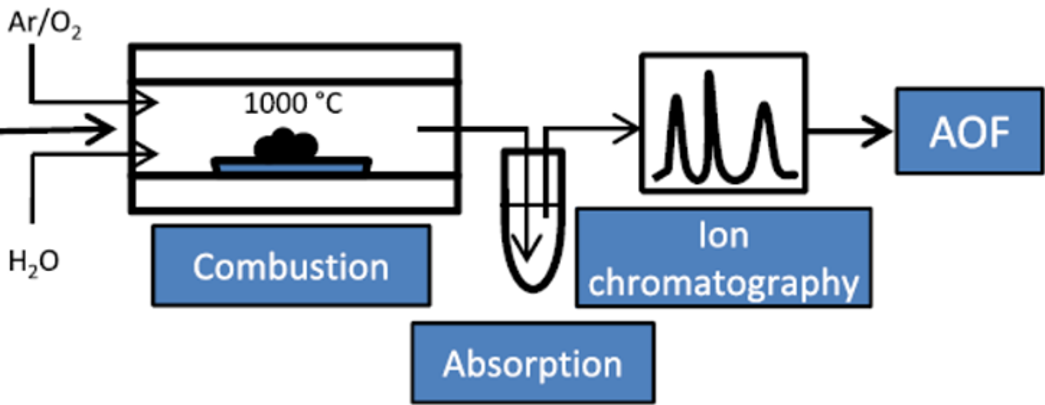
Figure 2. Schematic of CIC.5
Measurement and interpretation
Following AOF or EOF preparation, the retained carbon or cleaned extract is analyzed by CIC. Pyrohydrolytic combustion converts organically bound fluorine to hydrogen fluoride, which is collected in an aqueous solution and measured as fluoride by ion chromatography.
The reported results represent the aggregate fluorine recovered by the selected preparation technique, and are reported as µg F/L for aqueous samples or mg F/kg for solids. CIC does not identify the individual compounds contributing to the result.
Sample collection and handling
Table 2 summarises sample collection requirements for AOF and EOF. Samples should be collected in HDPE containers with linerless caps, with no chemical preservatives added. Protect samples from light, and refrigerate during storage and transport.
Table 2. AOF and EOF sampling requirements.
| Waters | Soils and solids | |||
| Test method | AOF | EOF | AOF | EOF |
| LORs | 0.5 µg/L | 0.2 mg/kg | ||
| Analytical technique | CIC | |||
| Test codes | E328 | E324 | E328 | E324 |
| Sample containers | 3 × 250 mL HDPE | 120 mL HDPE jar (no PTFE liner) | ||
| Storage temperature | ≤ 6°C (do not freeze), protect from light | |||
| Holding time | 90 days1 | 28 days2 | 90 days1, 2 | |
Expanding PFAS capability across Australia and New Zealand
Australian and New Zealand clients can arrange AOF and EOF testing through their local ALS project manager or local ALS laboratory. The ALS laboratory in Waterloo, Ontario holds ISO/IEC 17025 accreditation through the Canadian Association for Laboratory Accreditation (CALA) for AOF and EOF testing in water and solid matrices.
Contact us
Please contact your local ALS laboratory to discuss AOF and EOF testing, turnaround times, shipping and sample declaration requirements as required.
Melbourne
Melbourne Water
Sydney
Brisbane
Perth
New Zealand
Download as a PDF
References
1 United States Environmental Protection Agency, Method 1621 – Determination of Adsorbable Organic Fluorine (AOF) in Aqueous Matrices by Combustion Ion Chromatography (CIC), January 2024, accessed 15 September 2026, www.epa.gov/system/files/documents/2024-01/method-1621-for-web-posting.pdf.
2 United States Environmental Protection Agency, Method 1633 – Revision A – Analysis of Per- and Polyfluoroalkyl Substances (PFAS) in Aqueous, Solid, Biosolids, and Tissue Samples by LC-MS/MS, December 2024, accessed 15 September 2026, www.epa.gov/system/files/documents/2024-12/method-1633a-december-5-2024-508-compliant.pdf.
3 Heads of EPA Australia and New Zealand (HEPA), PFAS National Environmental Management Plan 3.1, 2 June 2026, accessed 15 September 2026, pp 69–70, www.dcceew.gov.au/environment/protection/publications/pfas-nemp-3 .
4 Ibid, pp 188–180.
5 E von Abercron, S Falk, T Stahl, S Georgii, G Hamscher, H Brunn & F Schmitz, ‘Determination of adsorbable organically bound fluorine (AOF) and adsorbable organically bound halogens as sum parameters in aqueous environmental samples using combustion ion chromatography (CIC)’, Science of The Total Environment, volume 673, 2019, doi.org/10.1016/j.scitotenv.2019.04.068 .