





























Design inputs for processing power

ALS conducts the majority of comminution tests required for plant design. The term "comminution" originates from Latin and translates roughly in English "to make particles small", which is one of the first processing duties of most plants on the feed ore. The energy to do so is also one of the largest costs of any industrial plant, and so comminution tests were established to predict those energy requirements and associated costs to power the crushers and mills.
Sieves

More than just a standard procedure

ALS has an entirely dedicated technician team and facility for comminution. We participate routinely in industry round robin tests to ensure accuracy and precision of our comminution results. In order to provide statistical certainty for engineering design modelling, comminution tests are designed as a fixed prescribed procedure, leading to the assumption that all laboratories results must be identical. Incorrect. There are critical maintenance and monitoring tasks required for the apparatus and media, preparation of standards, and simply fine nuances and ergonomics of each test that require long experience to achieve. Any oversight on these items will lead to biased results.

Moinho de bolas Bond

Comprehensive Capability

Common dry comminution tests conducted by ALS for engineering purposes are listed below in order of specimen/particle size:

  • Unconfined Compressive Strength (UCS) via two modern Servotronic hydraulic compression machines. Separate specimen tests conducted upon core specimens (either NQ, HQ, PQ diamond drill intervals of Cores drilled from Rocks).
  • Bond Impact Crushing Test (CWi). A traditional test conducted upon a set of rock specimens (typically 10 or 20) sized between 50 to 75 mm with two parallel faces.
  • Point Load Testing (PLT). A surface hardness test conducted upon selected specimens of typically >20 mm.
  • Autogenous Media Competency Tests (AMC). A proprietary SAG Mill competency test consisting of a tumble drum of broken pieces of PQ core, with Bond Impact Crushing Tests (CWi) conducted on survivors.
  • JK drop-weight test. Proprietary test developed by the Julius Kruttschnitt Mineral Research Centre (JKMRC) in Queensland, Australia conducted (under license) on selected specimen sets of various sizes from -50mm ore.
  • SMC Tests. Proprietary test developed by the SMC Testing Pty Ltd conducted under license on a set of 120 particles at the preferred size of –31.5 +26.5 mm, or in decreasing order –22.4 +19.0 mm and –16.0 +13.2 mm. A mass of 20 kg is usually required.
  • SAG Design (Starkey). Proprietary SAG Mill test (US).
  • Bond Abrasion Index (Ai) conducted upon charges of -19+12.7mm ore via a rotating impeller incorporating a Bisalloy of 500 Brinell hardness steel paddle within a contra-rotating drum.
  • Bond rod mill work index (RWi). Traditional dry grinding lock cycle test in a rod mill conducted on ore charges crushed to P100 12.7 mm.
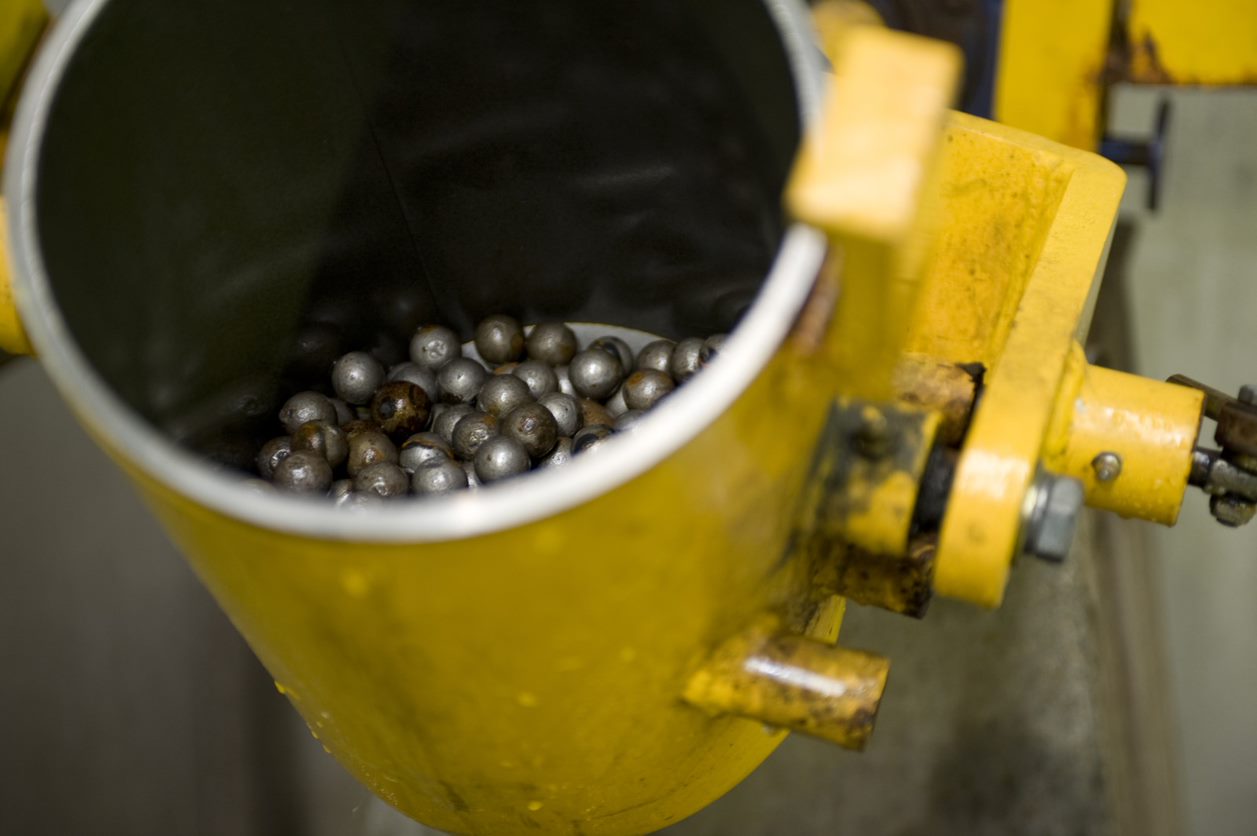
  • Bond ball mill work index (BWi). Traditional dry grinding lock cycle test in a ball mill conducted on ore charges crushed to P100 3.35 mm.
  • Levin open circuit grindability test. Test to ascertain grind size product from a fixed specific energy input – utilising the Bond Ball Mill.

Comminution also extends to wet grinding/milling and also to ultra-fine grinding (UFG) using stirred media mills. ALS conducts the following wet grinding and UFG tests:

  • IsaMillTM
  • Metso Jar Mill Test
  • DRA Milling Test
  • Metso Verti-mill
  • Deswik Stirred Media Detritor
  • Metprotech Mill

Similarly, comminution is also conducted at larger scale for high pressure grinding rolls (HPGR) and Pilot Semi Autogenous (AG/SAG/SABC) grinding. These items are discussed in more detail in our pilot operations section.

Here are some frequently asked questions

  • How much sample mass do I need for these tests?

    Keep in mind the mass may vary depending on the particle size distribution in order to contain the above particle sets, but some rough guidelines are as follows:

    • UCS, CWi, and PLT and simply require sufficient mass to obtain the required specimen sets. Soft or finer sized material may not be suitable for these tests and this provides an engineering outcome in itself (i.e. the ore is soft and will require very little crushing energy).
    • Autogenous Media Competency Tests (AMC) – 180 kg of PQ core.
    • JK drop-weight test – Typically, 50-90 kg of ROM ore (or crushed HQ or PQ core).
    • SMC Tests. A mass of 20 kg is usually required.
    • Bond Abrasion Index (Ai) – sufficient mass to produce 4 x 400 g of charges of -19+12.7mm ore.
    • Bond rod mill work index (RWi). Typically, 10-12 kg at the target crush size.
    • Bond ball mill work index (BWi). Between 6-10 kg at the target crush size will suffice depending on the number of cycles.
    • Levin open circuit grindability test. Between 4-6 kg will suffice depending on the number of power inputs.
  • Will ALS do Comminution on hazardous samples?

    Yes. ALS has a duplicated comminution room (Bond and JK Drop Tester) to treat fibrous and radioactive samples. Surcharges do apply, however, to cover safety equipment, monitoring and decontamination.

  • Our samples are from overseas, what do I do?

    ALS is a quarantine approved premises and treats many samples of oversea origin.  Strict regulatory requirements are in needed around packaging and paperwork, however.  ALS can advise you on these requirements.

Associated testwork services

Related testwork

Invariably, sample preparation is just the start of a metallurgical testwork program. Click the following links for other downstream test work services:


Click on the above links or contact us for further information. We can integrate a full program for you if required.