













 Procurar
 português



























 Iniciar sessão

EnviroMail™ 38 USA
Tire-Derived Chemical 6PPD-Quinone Linked to Salmon Mortality
Despite the significant societal value derived from the beneficial re-use of biosolids as agricultural fertilizer, there is growing international concern they may be a potential source of per- and polyfluoroalkyl substances (PFAS), posing a risk to human health and the environment.

A timeline of 6PPD-Q regulation
- Jan 30, 2024 – U.S. EPA releases Draft Method 1634 for 6PPD-Q using LC-MS/MS, now recognized as an EPA-accredited analytical method.
- June 13, 2024 – U.S. EPA publishes freshwater acute aquatic life screening values: 6PPD-Q (0.011 µg/L), 6PPD (8.9 µg/L).
- Sept 14, 2024 – Washington State enforces freshwater acute AL rule for 6PPD-Q (0.012 µg/L).
- Feb 11, 2025 – British Columbia issues short-term freshwater acute AL guideline for 6PPD-Q (0.010 µg/L).
As regulatory frameworks continue to advance, ALS remains committed to providing industry-leading analytical support for 6PPD-Q compliance and environmental monitoring.
6PPD-Q: Mystery salmon toxicant identified
“Urban Runoff Mortality Syndrome” (URMS) causes up to 90% of coho salmon to die before spawning in some urban creeks impacted by stormwater runoff in the US Pacific Northwest, particularly in the Puget Sound region. For decades, scientists were baffled by the cause of these high mortality rates, which mainly occur after high rainfall events. In December 2020, a research group led by Dr. Zhenyu Tian at the University of Washington reported on the team’s excellent scientific detective work (published in Science) that conclusively identified the mystery toxicant causing URMS as 6PPD-Q.
6PPD-Q was shown to be acutely toxic to coho salmon at very low concentrations (below 0.1 ppb). It is not yet known why other species of salmon, such as chinook, sockeye, Atlantic and chum, are far less sensitive to this chemical. The UW researchers initially identified 6PPD-Q in several streams in Washington and California. Since that time, considerable research has been done to measure and characterize 6PPD-Q in salmon-bearing streams of the US Pacific Northwest and British Columbia. Fish-bearing streams around the world are likely to be impacted by this chemical due to its ubiquitous nature and source. 6PPD-Q has now been shown to affect many other fish species such as rainbow trout, steelhead, brook trout, lake trout and coastal cutthroat trout.
Source of 6PPD-Q: a transformation byproduct of tire antioxidant 6PPD
The UW research group confirmed that 6PPD-Q was an oxidation byproduct of 6PPD, a widely used antioxidant which is added to car and truck tires at relatively high levels of 0.4–2%. 6PPD is a very reactive compound and is intended to preferentially react with ozone at the road surface to prevent tire degradation, which improves tire lifespan and safety characteristics. However, when 6PPD reacts with ozone, it converts to 6PPD-Q.
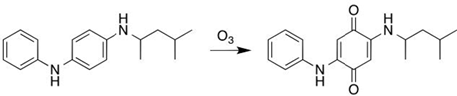
Normal driving and the progressive aging of tires cause abrasion of the tread, releasing tread-wear particles (TWPs)—microplastic debris—onto and around roadways. 6PPD-Q is water-soluble up to approximately 38 µg/L (20°C) and tends to dissolve into road runoff, finding its way into urban creeks, streams and rivers during storms and high rainfall events. After a long, dry summer, heavy rainfall in early fall often coincides with the migration of coho salmon into streams, when spawning grounds become accessible, which can create a deadly combination.
Measured LC-50 values for 6PPD-Q to coho salmon are extremely low, ranging from 0.041 to 0.095 µg/L. 6PPD-Q concentrations lethal to coho salmon have frequently been shown to occur in Washington State and British Columbia streams during high stormwater runoff events. In November 2023, an unprecedented die-off of coho salmon occurred in West Vancouver, BC at Brothers Creek – where returning coho salmon died before being able to spawn – which was linked to 6PPD-quinone.
Long-term environmental solutions
Given the ubiquitous global usage and distribution of 6PPD today, a long-term solution to this problem likely requires the re-engineering of automobile tire formulations to use anti-degradants that do not generate toxic byproducts like 6PPD-Q. Alternative short-term solutions in highly impacted fish-bearing streams could involve stormwater treatment or diversion, but these strategies may be cost-prohibitive on a large scale.
LC-MS/MS analysis of 6PPD-Q
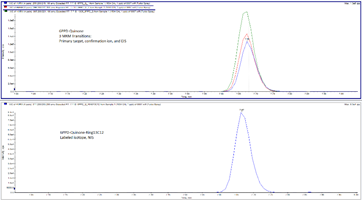
Recognizing the urgency of this issue when the story first broke, ALS immediately began work to develop a robust and sensitive test method for 6PPD-Q. Testing for 6PPD-Q in environmental waters is now conducted by ALS at our Kelso and Vancouver laboratories by Draft EPA Method 1634 with LC-MS/MS triple quadrupole technology, using multiple- reaction monitoring (MRM) of three independent mass transitions (see Figure 2). Quantitation is performed by isotope dilution, where a carbon-labelled 6PPD-Q analog is added to all samples prior to extraction to correct for sample matrix effects or sample extraction losses. Method 1634 uses a selective solid-phase extraction and cleanup protocol to deliver definitive, confirmed identification and measurement of 6PPD-Q down to trace levels.
Testing for the precursor: 6PPD
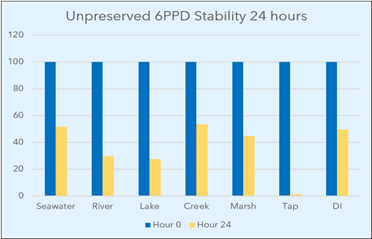
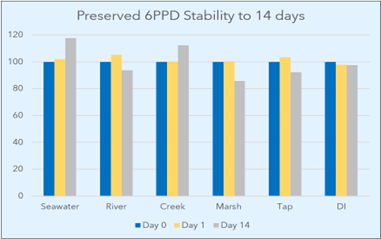
Environmental testing for 6PPD, the 6PPD-Q precursor and source material, is particularly challenging because 6PPD is highly reactive by design. 6PPD is added to tires specifically because it is sacrificially oxidized to prevent degradation of tire rubber. The aqueous half-life of 6PPD has been reported as being only a few hours under neutral pH conditions, even in sterile water, which ALS has verified (see Figure 3). However, ALS studies identified an optimal antioxidant preservative material and concentration that effectively stabilizes 6PPD for at least 14 days, facilitating its analysis with the same hold time as 6PPD-Q (see Figure 4).
Sampling requirements
Sampling requirements and test code details are shown in Table 1. Environmental water samples for 6PPD-Q or 6PPD may be conveniently collected in 125 mL amber glass bottles. Separate sample bottles are required for 6PPD, which are supplied pre-charged with antioxidant (non-hazardous). Samples should be chilled to ≤ 6°C prior to shipment to the laboratory if possible. ALS has adopted a hold time for these tests of 14 days (from sampling to extraction) based on US EPA Draft Method 1634 and on ALS stability studies for 6PPD.
Current ALS test method options in Kelso and Canada for 6PPD-Q include a routine limit of reporting (LOR) of 0.001 µg/L and ALS in Canada also offers a low-level LOR of 0.0002 µg/L (50x lower than freshwater acute aquatic life guidelines). Recent studies have shown that effective characterization of background levels in urban streams can be challenging due to temporal concentration surges, which can occur within minutes to hours of significant rainfall events; the use of a low-level method allows better characterization of background levels between surges.
|
ALS 6PPD and 6PPD-Quinone Reporting Limits and Sampling Details |
||||
| 6PPD-Quinone | 6PPD | |||
| Routine | Low-Level | Ultra-Trace Level | Routine | |
| Method Reporting Limit | 0.001µg/L | 0.0002 µg/L | TBD | 0.005 µg/L |
| Sampling Details | ||||
| Test Methods | LC-MS/MS | |||
| Sample Container | 2x 125mL Amber glass PTFE lined cap | |||
| Preservation | ≤ 6°C | Anti-Oxidant Pre-Charged | ||
| Recommended Holding Time | 14 days ( Draft EPA 1634)/28 days for extracts | 14 days | ||
The ALS laboratory in Kelso maintains NELAP accreditation for 6PPD-Q, and the ALS laboratory in Vancouver maintains ISO 17025 accreditation for 6PPD-Q and 6PPD through CALA. Please contact your ALS project manager for further details about these important tests.
References
Z. Tian et al., 2020. A ubiquitous tire rubber-derived chemical induces acute mortality in coho salmon, Science 10.1126/science.abd6951.
US EPA Federal Register, June 13, 2024. Acute Aquatic Life Screening Values for 6PPD and 6PPD-Quinone in Freshwater.
BC Ministry of Water, Land, and Resource Stewardship, 2025. 6PPD-quinone Water Quality Guidelines – Freshwater Aquatic Life. Water Quality Guideline Series, WQG-24. Prov. BC, Victoria BC.