























 Search
 English



























 Login
Login


EnviroMail™ 42
Elevating data quality: trace-level OC pesticide analysis using GC/MS/MS with 100 mL samples
ALS introduces a new organochlorine pesticide (OCP) method for water testing in the USA using 100 mL sample bottles and GC/MS/MS triple quadrupole instrumentation to set higher benchmark for data quality than traditional OCP approaches.

ALS is introducing a new organochlorine pesticide (OCP) method for water testing in the USA that leverages GC/MS/MS triple quadrupole instrumentation to deliver trace-level detection limits with a substantially reduced risk of false positives. The method uses 100 mL sample bottles and sets a higher benchmark for data quality than traditional OCP approaches based on single quadrupole GC/MS or GC/ECD (electron capture detection).
The sensitivity of this optimized GC/MS/MS method meets the most stringent USA standards and guidelines for OCPs in water without requiring large 500 mL or 1 L sample volumes. This advances ALS’ sample-volume reduction initiative by enabling fast and easy field collection and minimizing the potential for strain injuries associated with transporting large and heavy sample loads.
Applications and increased sensitivity
Our routine GC/ECD method remains appropriate for most regulatory programs and typical water matrices; however, the new GC/MS/MS method can achieve detection limits up to 10× lower while maintaining the same 100 mL sample volume. In addition to offering improved sensitivity, the GC/MS/MS approach enables enhanced selectivity, strengthening compound identification and overall data defensibility for clients operating to the lowest water quality criteria.
Sensitivity of the electron capture detector made GC/ECD methods the most appropriate analytical technique to meet the limits of quantitation for organochlorine pesticides (OCP) for many years. While adding additional confidence in qualitiative identification, single quadrupole GC/MS instruments do not have the sensitivity to meet the regulatory limits of all the compounds, limiting its use for this application.
Now however, the sensitivity of technology employed in the new GC/MS/MS method is in line with that of GC/ECD instruments, making the GC/MS/MS method an ideal upgrade to help meet regulatory limits while enabling improved data quality. In addition to improved sensitivity, the GC/MS/MS approach offers enhanced selectivity, strengthening compound identification and overall data defensibility for clients operating to restrictive water quality criteria requiring trace level limits of quantitation.
What is triple quad GC/MS/MS?
Both GC/MS and GC/MS/MS use gas chromatography to separate organic compounds over time on a capillary column interfaced to a mass spectrometric (MS) detector. In both techniques, eluting compounds are ionized (typically by electron ionization), producing characteristic mass fragments that are measured by the MS to support identification and quantitation.
GC/MS/MS adds a second stage of mass selection using multiple reaction monitoring (MRM), to deliver substantially greater selectivity and sensitivity. In MRM, a target precursor ion is isolated in the first mass analyzer and fragmented in a collision cell. A specific product (“daughter”) ion is then isolated and detected in the second mass analyzer. Because a compound must generate both the correct precursor ion and the correct product ion at the defined transition, GC/MS/MS can effectively suppress many matrix interferences that can affect single-quadrupole GC/MS. These highly selective MRM transitions help significantly strengthen analyte confirmation and improve quantitative accuracy for targeted compounds.
Data quality benefits of GC/MS/MS
Traditional single-quadrupole GC/MS and GC/ECD typically provide sufficient sensitivity and selectivity for relatively clean matrices such as surface water and drinking water. However, when trace detection limits are required –or when analyzing complex matrices (eg, wastewater and certain groundwaters) where co-eluting compounds and matrix interferences are more likely –GC/MS/MS generally provides the most reliable and defensible results while maintaining the smallest practicable sample volume.
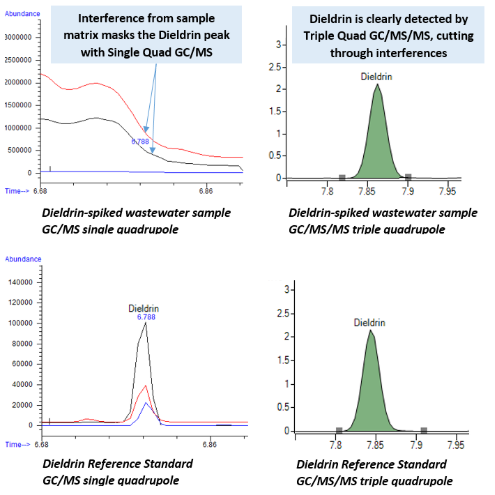
Fig 1. Effect of Interferences on GC/MS vs GC/MS/MS (same sample)
Figure 1 illustrates a representative example of single-quadrupole GC/MS interferences affecting the measurement of dieldrin in a wastewater sample. The lower chromatograms show reference dieldrin standards, while the upper chromatograms show the wastewater sample fortified (spiked) with dieldrin. Under single-quadrupole GC/MS conditions, a significant interference obscures the target response, which can result in a reported non-detect and/or an elevated Limit of Reporting (LOR). Under triple-quadrupole GC/MS/MS conditions, the same sample is analyzed using highly selective MRM transitions, enabling clear detection and quantitation of dieldrin without interference.
In addition to supporting trace-level reporting limits, the GC/MS/MS method can be used to address matrix interferences encountered in routine GC/MS and GC/ECD analyses of difficult samples. For some highly complex matrices (eg certain wastewaters), dilution may still be required to mitigate matrix effects; where dilution is applied, corresponding increases in trace-level LORs will occur.
Sampling considerations
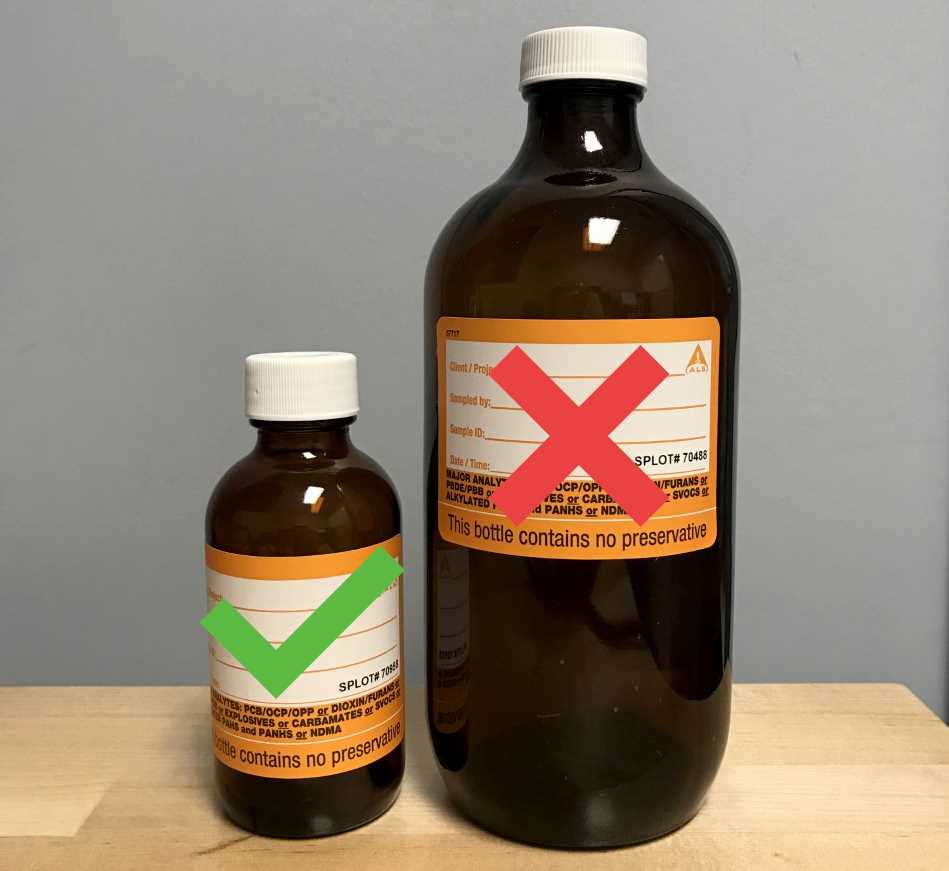
Fig 2. New 100 mL bottle & old 500 mL bottle
Water samples for the ALS’ trace OCP method requires sample collection in 100 mL amber glass bottles that have been validated by ALS for method suitability. For groundwater applications, it is critical to minimize sediment carryover to reduce the potential for positively biased results, as hydrophobic OCPs may sorb to suspended particulate matter. Low-flow sampling techniques are recommended to limit well disturbance and the entrainment of solids. Filtration is not permitted for OCP analysis due to the potential for analyte loss through sorption to filtration media. For chlorinated waters, samples must be preserved with sodium thiosulfate to quench residual free chlorine. The method holding time is 7 days.
ALS in Middletown, PA holds NELAC accreditation for the GC/MS/MS trace OCP method through Pennsylvania Department of Environmental Protection.
Please contact your ALS project manager with any questions, or to arrange for sampling supplies.
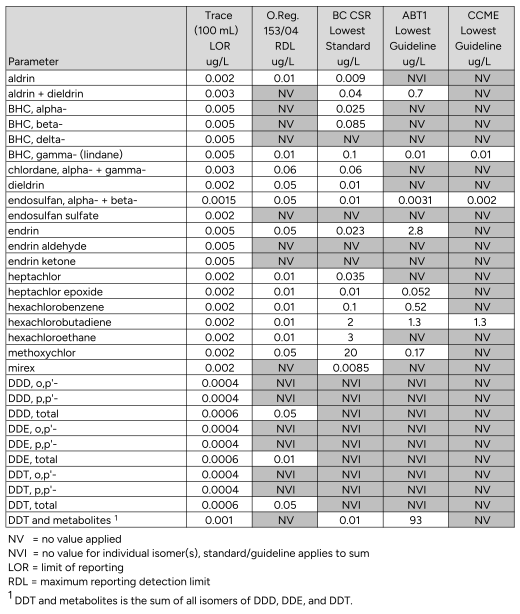
Table 1. ALS USA OCP Tests
Units: µg/L