




























 Login
Login


Innovation Award 2026
By reimagining repetitive laboratory processes through modular robotics and automation, an EMEA-based Environmental team has enhanced safety and efficiency while creating a flexible, scalable model with global potential.
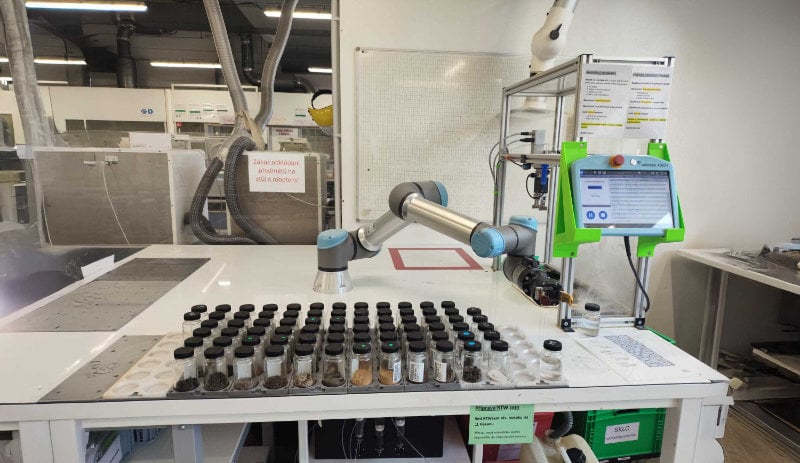
Inside EMEA's robotics program
When our Environmental team in EMEA set out to reduce repetitive manual handling in the laboratory, they had two goals: improve safety and free up employees to focus on higher-value work.
The team, led by Jens Stjernström, explored a range of commercial robotics systems and worked with external integrators, building on lessons from an earlier robotics trial in Denmark. Ultimately, they found that existing solutions lacked the flexibility needed for laboratory environments and came with significant implementation costs. Rather than compromise, the team decided to build their own approach.
The result is a modular robotics platform built using reusable "Lego-style" components that can be adapted and deployed across laboratories. By combining commercially available robotic arms with standardised modules such as dispensers, balances and barcode scanners, new automations can be developed faster and replicated across multiple sites.
Over several years, the platform has grown from a single concept into a program supporting laboratories across Europe, with expansion now underway in North America and APAC where first automations are being deployed.
Automation and Robotics Specialist Jaromír Vyhnanovský said the ability to reuse proven components has been central to the program's success.
"Once a module is proven, it becomes part of the library and the next robot is faster and easier to build because we're reusing things we already know work," Jaromír said.
Several solutions are already operating across EMEA laboratories, with additional systems in development and pilot phases. The program has improved safety by reducing manual handling, chemical exposure and repetitive strain injury risks, while also increasing consistency and throughput.
To date, the platform has completed more than 340,000 automated tasks. More importantly, it’s created a scalable model for laboratory automation, enabling sites to adopt proven solutions more quickly and helping accelerate innovation across the global ALS network.