
















 Search
 English























 Login
Login


EnviroMail 34 Update Canada
Extended PFAS Analyte Reporting and Trace-Level Testing by EPA Method 1633A
ALS now offers trace-level testing for up to 60 Per- and Polyfluoroalkyl Substances (PFAS) in surface water, groundwater, soil, sediment, and biosolids by US EPA Method 1633A — expanding the standard 40-analyte suite by an additional 20 compounds.

Extended PFAS Testing Suites by EPA 1633A
ALS has been testing for complex suites of PFAS analytes globally under accredited methods since the late 2000s, supporting global trends to monitor and restrict these persistent chemicals in the environment. What started out as testing for PFOS and PFOA has steadily grown to include dozens of new compounds as PFAS regulation and knowledge of their precursors and degradation processes increases. The ALS global network of expert PFAS scientists are constantly developing new capabilities to meet local and global testing needs. This includes global reviews of emerging analytes, including those becoming increasingly regulated or requested by our global customers. The availability of testing for expanded parameter lists reduces the risk of underestimating cumulative PFAS impacts.
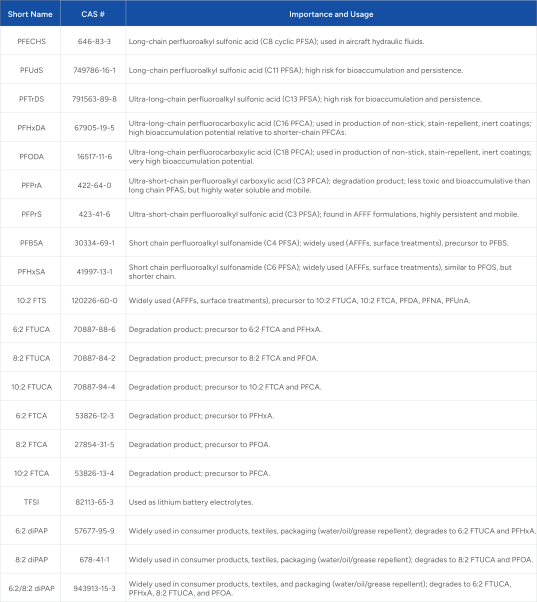
In 2021, ALS added 11 analytes beyond the EPA 1633 analyte list, including PFECHS (found in aviation hydraulic oils) and several fluorotelomer carboxylic acids (FTCAs and FTUCAs, which can be major PFAS components of legacy landfill leachates). From 2023 to 2026, we added 9 more important analytes, including 4 short and ultra-short PFAS (PFPrA, PFPrS, PFBSA, PFHxSA) and 3 widely used polyfluoroalkyl phosphate diesters (diPAPs). The ALS extended PFAS suites for Method 1633A now include up to 60 PFAS analytes, as shown in Table 3. Please refer to Table 1 for a concise summary of all our extended-list PFAS analytes, with information about their usage and importance.
Table 1. PFAS Analytes in Extended Suites beyond 1633A list
Expanding Canadian PFAS Regulations
PFAS guidelines and regulations in Canada are expanding quickly. The first Canadian PFAS regulations were issued in British Columbia in 2017 under the BC Contaminated Sites Regulation. CCME water and soil quality guidelines and a scientific criteria document were released in September 2021. The Canadian Maritime provinces issued new regulations for 9 individual PFAS in July 2022 under the Atlantic Canada RBCA Environmental Quality Standards. In January 2023, Alberta added PFOS and PFOA to their Tier 1 Soil and Groundwater Remediation Guidelines. And on August 9th 2024, Health Canada published the Objective for Canadian Drinking Water Quality for PFAS, setting a maximum objective concentration of 30 ng/L for the sum of 25 specific PFAS (refer to EnviroMail 62 for more information about PFAS in drinking water). This objective replaces the Canadian drinking water guidelines and screening values issued in 2018 and 2019.
Detection limits achieved by our EPA 1633A tests are below all established and proposed limits in Canadian PFAS regulations and CCME guidelines, with most below the lowest of any global PFAS regulatory guidelines from the USA, Europe, or Australia (refer to compilation published by ITRC, the US Interstate Technology Regulatory Council).
Highlights of EPA Method 1633A
The December 2024 version of Method 1633A provides performance-based method guidance and performance requirements for testing of 40 PFAS analytes in waters, soils, biosolids, and tissues, in support of the US PFAS Strategic Roadmap and US Clean Water Act (CWA). ALS in Canada is applying Method 1633A for trace-level analysis of our extended PFAS suite in wastewaters, surface waters, groundwaters, soils, sediments, and biosolids. Our test offerings meet all requirements of Method 1633A, including:
- LC-MS/MS with Multiple Reaction Monitoring (MRM);
- Whole-sample bottle extraction for waters (representative subsampling is used only for high-level samples identified by pre-screening, and is indicated on reports);
- Soils and sediments are extracted three times with 0.3% methanolic ammonium hydroxide;
- Solid Phase Extraction (SPE) and carbon cleanup steps are used for isolation and concentration of PFAS from sample matrix, and to minimize interferences;
- All required isotopically labelled Extracted Internal Standards (EIS) and Non-extracted Internal Standards (NIS) are incorporated and assessed against specified QC limits;
- Quantification is based on isotope dilution or extracted internal standards;
- Both linear and branched PFAS isomers are quantified for all PFAS for which linear/branched reference mixtures are available (PFOA, PFNA, PFOSA, PFOS, PFHxS, NMeFOSA, NEtFOSA, NMeFOSE, NEtFOSE, NMeFOSAA, NEtFOSAA);
- All water samples are pre-screened for PFAS and TSS to prevent cross-contamination and to determine optimal SPE sample preparation strategy.
EPA Method 1633A is designed to provide top-quality ultra-trace PFAS analysis for an extensive analyte list, with exceptional resolution from potential interferences through optimized cleanup procedures, chromatographic separations, and MS/MS conditions.
More on PFAS in Soils, Sediments, and Biosolids
For more details about PFAS in soils and sediments, please refer to EnviroMail 59, which includes a comprehensive compilation of Canadian soil criteria for PFAS, including the Health Canada PFAS Soil Screening Values for Federal Contaminated Sites.
For more details about PFAS in biosolids, please refer to EnviroMail 68, which includes a summary of all current & pending Canadian PFAS biosolids regulations.
Sampling Considerations
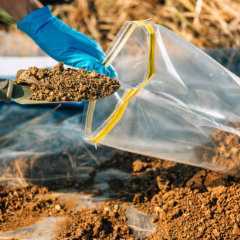
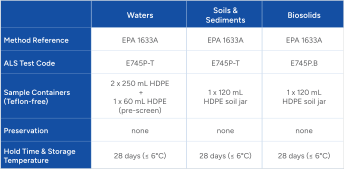
Table 2 summarizes sample collection requirements for trace-level PFAS analysis by EPA Method 1633A. Trace-level testing of waters requires submission of 2 x 250 mL sample containers to permit whole-sample analysis with SPE with an option for re-analysis if required. An additional 60 mL sample is also required for pre-screening and TSS testing. Trace-level testing of soils, sediments, and biosolids requires a single 120 mL HDPE soil jar.
Samples should be protected from light and shipped with sufficient ice to maintain temperature at 0-6°C from the time of collection until arrival at the laboratory. Allow at least 48 hours to account for shipping delays. For cooling of PFAS samples, ALS recommends double-bagged regular ice in sealed poly bags (e.g., Ziploc®), or HDPE bottles filled with water and frozen. Chemical or “blue” ice should be avoided (many brands are in use and most are untested for PFAS).
A 28 day hold time is applied for all 1633A tests; however EPA indicates that NMeFOSE, NEtFOSE, NMeFOSAA, and NEtFOSAA have reduced stability in waters (7 days), and NFDHA has reduced stability in soils/sediments/biosolids (3 days). If these are analytes of particular concern at a site, please contact ALS to arrange for expedited analysis.
Table 2. PFAS Sampling Details
ISO 17025 Accreditation and Further Details
Our Canadian PFAS specialty laboratory in Waterloo offers ISO 17025 accredited testing for an extensive and rapidly expanding PFAS parameter suite in environmental waters, soils, sediments, and biosolids by US EPA Method 1633A. Please refer to the CALA scope of accreditation for ALS in Waterloo for current status.
Table 3. ALS Extended PFAS Analyte Suites
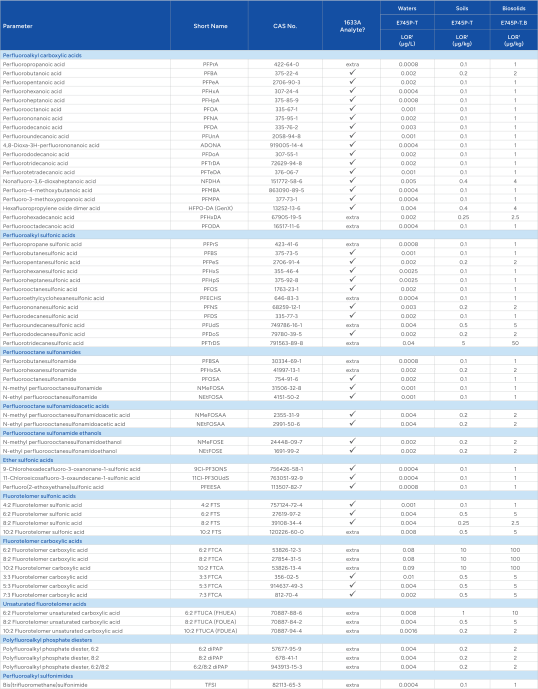 1 Trace-level Limits of Reporting (LORs) may not be achievable for high-level contaminated samples.
Please contact your ALS Project Manager for further information or to arrange for sampling supplies.
