



























 Search
 English



























 Login
Login


EnviroMail™ 165 Australia
Quantification of cyanobacterial and cyanotoxin genes by qPCR: Enabling early cyanotoxin risk assessment

Under favourable conditions such as elevated nutrient availability, warm temperatures and stable water columns, cyanobacterial populations can increase rapidly and form blooms. These blooms pose multiple risks, including the potential production of cyanotoxins that can harm aquatic ecosystems and present risks to human and animal health (NHMRC 2011, updated 2022– 2025).
Importantly, not all cyanobacteria produce toxins. The capacity for cyanotoxin production depends on the presence of specific toxin biosynthesis genes (Kardinaal et al. 2007, Christiansen et al. 2008), while environmental conditions influence whether those genes are expressed. As a result, visual blooms or elevated cell counts do not necessarily reflect toxin risk, and traditional monitoring approaches alone offer limited early insight into toxin potential (Chorus & Welker 2021).
qPCR addresses this limitation by offering a rapid and sensitive monitoring tool for detecting cyanobacteria and cyanotoxin genes. When incorporated into monitoring programs, qPCR can support earlier and more proportionate decision-making during bloom development, particularly at stages when management interventions are most effective.
Advantages of PCR analysis
The key advantage of PCR analysis lies in its ability to directly target associated genes at low abundance and generate quantitative data relevant to early risk assessment. Rather than relying on visible bloom formation or delayed toxin confirmation, PCR detects the genetic capability of cyanobacteria to produce toxins. This enables earlier identification of elevated risk during the initial stages of bloom development.
Unlike microscopy, which cannot always differentiate toxigenic from non-toxigenic strains within the same genus, PCR directly targets cyanotoxin biosynthesis genes. This allows clearer distinction between benign cyanobacterial presence and populations with hazardous potential.
qPCR also enables temporal assessment of toxin gene abundance, providing insight into changes in toxin-producing cyanobacterial populations over time. These data provide early indication of increasing toxin risk and support timely escalation to targeted toxin analysis, increased surveillance or operational response. Where well- established relationships exist between gene abundance and toxin concentrations, quantitative results may support the application of trigger-based thresholds (Pacheco et al. 2016) (figure 1). Conversely, when toxin genes are not detected, this can support confident de-escalation where appropriate.
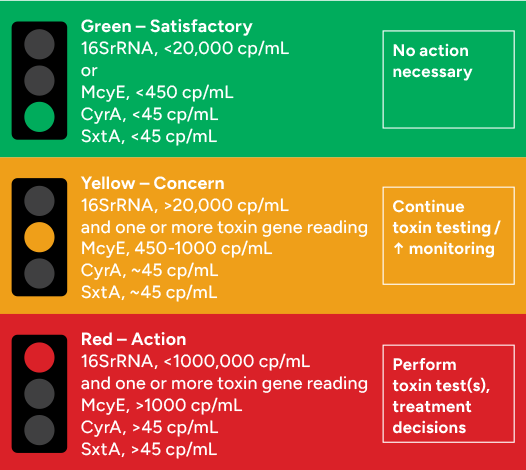
Figure 1. Trigger-based thresholds for the CyanoDTec Assay (manufacturer-recommended).
Regulatory context
Australian cyanobacteria management frameworks adopt a preventive, risk-based approach. The Australian Drinking Water Guidelines emphasise early detection, graduated response and verification rather than fixed compliance limits (NHMRC 2011, updated 2022-2025). Within this framework, biovolume-based alert levels are widely used to guide investigation and escalation.
Molecular approaches such as qPCR complement these indicators by directly identifying toxin-producing cyanobacteria (Pinheiro et al. 2025). This can provide earlier and more specific information on toxigenic potential, without requiring significant biomass accumulation.
While PCR is not a regulatory compliance requirement in Australia, it is increasingly used by water authorities as a supporting line of evidence (WaterRA 2025). Its application enables:
- earlier identification of toxin-producing potential
- more selective escalation to toxin testing
- improved confidence in management decisions.
This approach is consistent with modern risk management principles applied across water quality monitoring in Australia.
A molecular workflow for cyanotoxin assessment
To support risk-based cyanobacteria management, ALS provides an integrated molecular workflow for the quantitative analysis of cyanobacterial and cyanotoxin genes under Method MM316. This method aligns with Standard Method SM 10120 (WaterRA 2025), which was established through an international study involving ALS.
The assay is designed for environmental monitoring and directly targets genetic markers associated with both cyanobacterial presence and toxigenic potential (figure 2), including:
- Total cyanobacteria via cyanobacteria-specific 16S rRNA gene
- Microcystin and nodularin genes (mcyE / ndaF)
- Cylindrospermopsin gene (CyrA)
- Saxitoxin gene (sxtA).
An internal amplification control (IAC) is included in every sample to confirm assay performance and identify the presence of PCR inhibition, supporting reliable interpretation across complex water matrices (Bustin et al. 2025). In bloom‑affected surface waters, PCR inhibition may result from dissolved humic substances from catchment inputs, as well as elevated organic loads associated with cyanobacterial blooms. Where inhibition is identified, sample dilution may be required to achieve acceptable assay performance, resulting in higher reporting limits. Reporting limits will also be raised for highly turbid samples where only a reduced volume can be filtered.
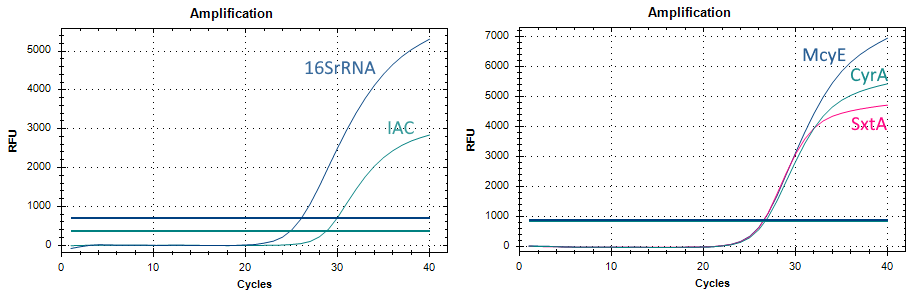
Figure 2. Amplification plots for CyanoDTec Assay targets: 16S rRNA and IAC (left), and McyE, CyrA and SxtA (right).
Results are reported as gene copies per millilitre and provide quantitative information on the presence and relative abundance of cyanobacteria and toxin genes. This also enables the potential to track changes in toxigenic risk over time.
Detection of toxin genes indicates genetic capability for toxin production, rather than confirmed toxin presence or active toxin expression. Conversely, the absence of toxin genes provides supporting evidence of a low likelihood of toxin generation, even where cyanobacteria are present. Monitoring programs typically apply qPCR alongside microscopy, interpreting results in conjunction with biovolume, environmental conditions and other operational data. Where warranted, results may be escalated to quantitative cyanotoxin analysis by LC-MS/MS (NHMRC 2011, updated 2022-2025; Queensland Health 2023).
Verification and data quality
Confidence in cyanotoxin qPCR results is underpinned by demonstrated proficiency testing and interlaboratory performance. ALS participated in a National Measurement Institute (NMI) interlaboratory study assessing qPCR performance for cyanobacteria DNA reference materials and achieved satisfactory performance across all reported targets. Results agreed with assigned reference values and fell within established acceptance criteria for environmental qPCR methods (Pinheiro et al. 2025).
This builds on ALS internal verification, which confirmed reliable quantitative performance for total cyanobacteria (16S rRNA) and toxin gene targets across relevant freshwater matrices. Internal quality controls, including internal amplification controls, consistently confirmed workflow integrity and identified inhibition when present.
Verification of the qPCR workflow demonstrated:
- Robust quantitative performance across cyanobacteria and toxin gene targets
- Minimal inhibition in freshwater and recreational water matrices
- Strong interlaboratory agreement.
Together, internal verification outcomes and independent proficiency testing demonstrate that the cyanotoxin qPCR workflow delivers consistent, reproducible and reliable data. These outcomes support the use of the method as a monitoring tool for assessing cyanobacterial abundance and toxigenic potential.
Method specifications
ALS provides qPCR analysis of cyanobacterial and cyanotoxin genes. Samples should be collected and stored in accordance with the specified guidance to ensure data integrity (table 1).
Table 1. Details of the cyanobacterial and toxin gene qPCR method
| Parameter | Specification |
| Method code | MM316 |
| Analysis name | W-CYAN-PCR |
| Matrices | Potable water, surface water, recreational water |
| Sample volume | 100 mL |
| Holding time | 48 hours |
References
Bustin SA, Ruijter JM, van den Hoff MJB, Kubista M, Pfaffl MW, Shipley GL, Tran N, Rödiger S, Untergasser A, Mueller R, Nolan T, Milavec M, Burns MJ, Huggett JF, Vandesompele J and Wittwer CT (2025) MIQE 2.0: Revision of the Minimum Information for Publication of Quantitative Real-Time PCR Experiments guidelines. Clin. Chem. 71(6), 634–651. doi:10.1093/clinchem/hvaf043Chorus I and Welker M (2021) Toxic Cyanobacteria in Water: A Guide to Their Public Health Consequences, Monitoring and Management. 2nd edn. CRC Press, Boca Raton. doi:10.1201/9781003081449
Christiansen G, Molitor C, Philmus B and Kurmayer R (2008) Nontoxic strains of cyanobacteria are the result of major gene deletion events induced by a transposable element. Mol. Biol. Evol. 25(8), 1695–1704. doi:10.1093/molbev/msn120
Kardinaal WEA, Tonk L, Janse I, Hol S, Slot P, Huisman J and Visser PM (2007) Competition for light between toxic and nontoxic strains of the harmful cyanobacterium Microcystis. Appl. Environ. Microbiol. 73(9), 2939–2946. doi:10.1128/AEM.02892-06
National Health and Medical Research Council (2011, updated 2022-2025). Australian Drinking Water Guidelines. National Health and Medical Research Council, Canberra.
Pacheco ABF, Guedes IA and Azevedo SMFO (2016) Is qPCR a reliable indicator of cyanotoxin risk in freshwater? Toxins 8(6), 172. doi:10.3390/toxins8060172
Pinheiro LB, van Asten M, Antin L, Adams H, Qiu JY, Robinson M, DeLorenzo S, Holmes R, Hurd M, Tang R, Clausen K, Seikel J, Sudhi R, Wright P, Steiner K, Gérard A, Bhat S, Baoutina A and Emslie K (2025) Interlaboratory performance study of cyanobacteria DNA reference materials using a qPCR format for monitoring cyanobacterial blooms. AWWA Water Sci. 7(2), e70018. doi:10.1002/aws2.70018
Queensland Health (2023) Harmful algal blooms (cyanobacteria) – guidance and alert levels.
WaterRA (2025) Breakthrough in Water Quality Monitoring: CyanoDTec Assay Published as Standard Method SM 10120. Water Research Australia.