






























Iron ore magnetite processing (LIMS, MIMS, WHIMS, Davis Tubes)

The increased worldwide demand for steel in recent decades has led to an increase in the exploitation of magnetite iron ore deposits as an alternative to hematite DSO ores. Magnetite concentrate is a higher-grade product than hematite and very desirable as a smelter feed. However, the caveat for this superior product is the requirement for more complex, and higher cost, beneficiation circuits. Our expert magnetite team of metallurgists can work with you and your consultants to optimise existing magnetite beneficiation circuits or provide crucial data for feasibility studies, mine planning and marketing purposes.
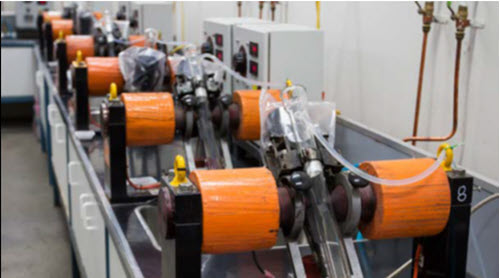
Tubos Davis Processamento de magnetite de minério de ferro

Magnetic separation testwork services

In addition to the many generic testwork tasks and equipment such as sample preparation, chemical analysis, and grinding, the core principle of testing for magnetite ores is magnetic separation.

At the IOTC, ALS has an extensive range of magnetic separators suitable for all batch and most continuous scenarios, as follows:

  • Davis Tubes: The traditional Davis Tube forms the bedrock of every magnetite program in determining the initial weight-recovery response of magnetic iron. This will indicate the proportion of the deposit that is magnetite and the likely grade of concentrate at a given grind size. The most common test is the standard DTR (Davis Tube Recovery), which incorporates a time efficient ring pulverising stage (i.e. via LM2) followed by the DTW (Davis Tube Wash) test. The DTW test can also be performed independently on any sample processed by other means (e.g. grinding, or plant samples). At the IOTC, ALS has an entire laboratory area dedicated to Davis Tubes with up to 10 units operating around the clock when necessary. The Davis Tube laboratory also has all the necessary ancillary infrastructure to process hundreds of DTW's per day.
  • Wet LIMS (Low Intensity Magnetic Separation) Eriez L8 Electromagnetic Drum Separators (multiple units): The L8 has an adjustable electromagnet to deliver low intensity gauss field strengths between 500 to 1150G. The L8s can treat small 2-10 kg batches of slurry or be run in continuous mode via a pump feed. Continuous throughputs are between 50-200 kg/h depending on the material characteristics. A frame arrangement of 3 x units cascading in series is available for piloting work.
  • Larger Scale LIMS and MIMS (Medium Intensity Magnetic Separation) Drum Separators: The IOTC has a comprehensive range of drum separator for both low and medium intensity gauss fields, as follows:
    • Large Scale Eriez Wet LIMS RMS (Rougher Magnetic Separation) Drum Separators. Two industrial sized pilot units are available at 1100 mm Dia and 1150G and 900 mm Dia and 900G, which can be integrated into pilot grinding circuits of run independently.
    • Medium Scale Wet MIMS RMS Separators. Two units are available inclusive of the Eriez MIMS counter-rotation wet drum at 610 mm width x 400 mm diameter measuring 6,300G at 1.5 mm from the surface, and a Longi triple drum/bath unit running at gauss fields of 5,000, 6,000 and 7,000 G for each drum/bath. These units require larger batches for continuous flow, or as integrated unit processes in pilot plants. Slurry throughput rates range from 50/200 kg/h depending on materials characteristics and % solids concentration.
    • Medium Scale Eriez Dry MIMS Drum Separator: This 1 m x 450 mm drum is equipped with 3 x internal permanent magnets of 3,000, 6,000 and 7,000G. A movable feed hopper and belt feeder arrangement slides along the width of the drum to direct feed over the selected magnet. The unit requires a minimum mass of 10 kg and up to many hundreds of kilograms.

  • Small Scale Batch WHIMS (Wet High Intensity Magnetic Separation) VPHGMS (Vertical Pulse High Gauss Magnetic Separation): ALS holds both the Slon 100 and the Longi 100 units for assessing WHIMS on smaller ~100 g samples. The batch VPHGMS units utilise a pulsating bath of slurry through a single cage/matrix of iron rods surrounded by a high gradient electromagnet (up to 1.8 tesla). Magnetic material is trapped in the cage within the magnetic field and non-magnetics are wash out. These smaller tests are useful in determining indicative material magnetic response and optimum test parameters ahead of larger scale testing.
  • Larger Scale VPHGMS Separators: Two larger SLon and Longi VPHGMS unit are available to process large masses through high magnetic field strength up to 1.2T. These units employ a vertically oriented rotating carousel of rod cages as opposed to the single cage chamber of the SLon 100 and Longi 100 units. The mid-size Longi 500 unit can process sample batches in the range of 15-30 kg, and can be run continuously at approximate throughput rates of 50 kg/h. The larger SLon 750 is specifically suited to larger masses of hundreds of kilos, or tonnes, or integrated into a pilot plant.
  • Small Scale Dry High Intensity Mical Separator: This unit is a simple electromagnetic device to process a flow of small samples of dry <1.00 mm particles through adjustable field strengths up to 18,000G.

Other related services

Magnetic separation almost always occurs in conjunction with sample preparation or chemical analysis and beneficiation testwork.

Don't quite see what you're looking for or need more information?

Magnetic separation is a simple and robust separation process, but the application of different units and field strengths relative to ore types can be complicated. ALS can advise you on the best options for magnetite ore evalutation.


Please contact us for further details.

Here are some frequently asked questions

Associated testwork services

Related testwork

Magnetic separation almost always occurs in conjunction with:

Click on the above links or contact us for further information. We can integrate a full program for you if required.