





























Scrubbing & beneficiation piloting

Scrubbing & beneficiation piloting

Many mineral ore types are hosted in clays (e.g. Smectites or Kaolinites), which by nature have extremely fine size distributions (<5 µm) that do not require grinding. Many clays, however, exhibit plastic or swelling characteristics and are tightly agglomerated to strongly resist forming a slurry via water addition only. Scrubbing is the process of adding tumbling and/or shear energy to a clay bearing ore-water mix to break up agglomerates and produce a free- flowing slurry. Beneficiation is the concentration of valuable minerals post grinding or scrubbing. ALS has an extensive batch and pilot scrubbing, and beneficiation, capability and has the operational know-how to take your scrubbing and beneficiation pilot to a successful outcome.
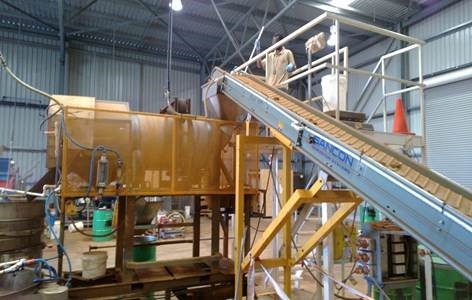
Fábrica de depuração

Scrubbing and Beneficiation Piloting Services

Although simple in concept, scrubbing is difficult to measure and can be one of the most subjective and challenging processing steps. As such, a comprehensive batch program may need to be completed before to proceeding to continuous pilot operation. Beneficiation is a wide-ranging area of processing with many mechanisms and proprietary equipment available for mineral separation and concentration. Some of the common scrubbing and beneficiation techniques available to clients at ALS are described below.


Scrubbers:
  • Drum Scrubbers - Batch: Three batch scrubber types are available to assess scrubbing speed, duration, %solids, and media addition, as follows:

    • Small 300 mm Dia x 550 ESL variable speed scrubber with 2 x 50 mm lifters. Suitable for indicative testwork using 2-5 kg charges.
    • Custom high aspect 950 mm Dia x 100 mm width scrubber with 16 x internal lifters, suitable for 10-20 kg charges.
    • ISO 1,000 mm Dia x 500 mm ESL drum Scrubber with 2 or 4 internal 50 mm lifters, suitable for charges between 20 and 50 kg.

  • Drum Scrubbers - Pilot: ALS has two continuous drum scrubbers:

    • Continuous 640 mm ID Dia x 1210 mm ESL with a 750 mm detachable trommel screen. The circular feed pipe bend has a wide internal diameter of 205 mm, which gives give a nominal feed particle top size of 100 to 120mm. A rubber seal is installed around the feed pipe. An extended 450 x 450 mm hopper is installed to received feed via a Sanki conveyor. The unit is bare mild steel and can take feed rates of between 100 to 500 kg/h. The scrubber also has a range of removable discharge retaining rings, which can be bolted to a welded minimum ring width is 50 mm (off the shell ID), thereby increasing retention volume and time.
    • Continuous 2.50 m ESL x 0.925 m Dia rotating unit, which can take feeds of between 0.5- 2 tph depending on the material characteristics and testwork objectives. Variable speed is achieved through electronic power frequency control and typical speeds are 17-30 rpm. The unit is rubber lined and has 6 x 50 mm standard square profile lifters installed. The feed end has a large integral hopper and 200 mm feed chute arrangement that can be fed directly from a conveyor discharge. The discharge end has a 450 mm trommel screen attached to the scrubber. A dual discharge hopper can direct trommel oversize and undersize to two different streams. The unit is also high enough to fit a small vibratory screen underneath the trommel undersize chute for secondary screening.

  • Logwasher: ALS has a 1,900 x 450 twin shaft logwasher with each fitted with 16 x 4 sets of angle paddles. The unit has a position adjustable feed chute and top discharge with the bath angled at a fixed 7.5 Degrees. The logwasher is variable speed and take typical feed rates of 50-200 kg depending on material characteristics. This unit is suitable for continuous scrubbing applications where additional shear energy is required for agglomerate breakage. It can be operated independently or in series with drum scrubbers.

Feed Arrangements and Slurry Handling: As with milling, ALS has all of the before and after materials handling arrangements for pilot scrubbing and beneficiation. ALS has a range of different sized feed hoppers and belt/screw feeders to match the scrubber size. Similarly, a range of slurry pumps in various sizes is available to handle scrubbed slurry including: Open bowl Sala and Metso pumps, Warman AH Slurry pumps, Bredle peristaltic hose pumps and Sandpiper peristaltic diaphragm pumps. In combination, the above equipment can meet most pilot scrubber solutions.


Beneficiation Circuits:
  • Screening and Hydro-cyclone Classification: Any bimodal rock components are often barren of valuable mineral and simply need to be rejected on a size basis by screening or hydro-cyclones. Whether by conveyor or pumping systems, ALS can set-up a custom circuit to take scrubber product streams for almost any combination of classification by size and/or SG.
  • Spirals: ALS has a dedicated spiral rig set-up at the Iron Ore Technical Centre (IOTC) for spiral specific optimisation testwork. The rig holds four spirals and can be configured for rougher and cleaner circuits. ALS does not keep a large inventory of spirals, but rather fosters good operating alliances with the major spiral manufacturers (e.g. Mineral Deposits, Multotec and Alicoco) to borrow various spirals to suit the testwork program.
  • Magnetic Separation: ALS has a comprehensive range of magnetic separation options as follows:
    • Wet LIMS (Low Intensity Magnetic Separation) Eriez L8 electromagnetic drum separators (multiple units). The L8 typically take throughputs of 50-200 kg/h and can deliver Gauss setting of 500 to 1150G. The L8s can be run separately of in cascading series.
    • Large scale Eriez wet LIMS RMS (Rougher Magnetic Separation) drum separators. Two units are available at 1100 mm Dia and 1150G and 900 mm Dia and 900G, which can be integrated into grinding circuits of run independently.
    • Batch and pilot scale VPHGMS (Vertical Pulse High Gauss Magnetic Separation) units are available, which use the system of a vertical ring of rod matrices rotating through a pulsating bath of slurry surrounded by a high gradient electromagnet (up to 1.8 tesla). ALS holds the Slon 750 pilot unit and the Longi 500 (batch and pilot), both of which can be operated independently or integrated into a pilot circuit.
  • Jigging: ALS houses a large pilot scale proprietary AllMineral continuous pilot jig suitable for feeds up to one tph at the IOTC in Wangara Western Australia.
  • Flotation: ALS has one of the large ranges of pilot flotation expertise and capability in the world at its Balcatta facility. Click here for more detail.
  •  

Need more information or want to devise a specific scrubbing and/or beneficiation circuit?

ALS can meet your needs and can also leverage off vendors for specific or non-conventional equipment items.

Please contact us for further details.


Here are some frequently asked questions

  • How much mass does a typical batch scrubbing program require?

    Typically, 300-500 kg depending on how many parameters are testing.

  • How much mass does a typical pilot scrubbing/beneficiation program require?

    This will depend on the scope of work and downstream and product requirements. Sample masses can range from a few tonnes to 60 tonnes.

  • Why is scrubbing so difficult to measure and quantify?

    Scrubbing is one of those processes that either works or it doesn’t insofar as producing a flowing slurry free of clay balls and agglomerates. Scrubbing efficiency is usually measured by the degree of clay ball formation (i.e. number, size and weight). Rarely if ever is there a scenario whereby clay balls are desirable and measuring the clay ball characteristics provides little value. Feed conditions and input energy is usually adjusted to the point where a clean free flowing slurry is produced, or other processes are considered if not.

  • What the parameters that affect scrubbing performance?

    Scrubber speed, duration, and the amount of water addition are the main parameters. Particularly plastic clays may need some media addition or require additional shear energy.

  • Will ALS do toll scrubbing services?

    Typically, no. Contact us to discuss.

  • Will ALS hire out its scrubbers?

    Generally, no. We need our equipment at our labs and hire is not our core business.

  • Will ALS treat hazardous samples?

    Generally, yes. ALS has facilities and procedures to treat fibrous and radioactive samples. Surcharges do apply, however, to cover safety equipment, monitoring and decontamination.:

  • Our samples are from overseas, what do I do?

    ALS is a quarantine approved premises and treats many samples of oversea origin. Strict regulatory requirements are in needed around packaging and paperwork, however. ALS can advise you on these requirements.

  • Can I do my own testwork at ALS?

    Generally, no. Insurance and safety protocols typically prevent renting laboratory space and this is not part of ALS’s business model. Clients are able to visit and witness testwork but this is to observe only. Typically, clients may attend on 24/7 piloting campaigns and interact with senior staff members for technical and operational issues.

  • Can my associates and I view the testwork at ALS?

    Yes, clients are always welcome to visit our facilities and observe samples or tests in progress. Inductions are required and other rules may apply to visitors.

  • Will ALS dispatch my samples to third parties?

    Yes, if a testwork program is in progress, ALS will happily dispatch testwork products and feed samples to vendors, third party laboratories, and customers as required. Fees apply.

  • Does ALS do design engineering and consulting?

    No, as it is not our core business and would put us in direct competition with many of our clients. We can, however, put you in contact with a range of reputable engineering providers and consultants.

Associated testwork services

Related testwork

Grinding always precedes other processes, both at bench scale and pilot scale that may include:

Click on the above links or contact us for further information. We can integrate a full program for you if required.