
























 Search
 English



























 Login
Login


EnviroMail™ 164 Australia
Planktonic Algae and Cyanobacteria: monitoring practices for assessing water quality
Planktonic algae and cyanobacteria, also known as phytoplankton, occur naturally in environmental waters, living suspended in the water column.

These microscopic, photosynthetic organisms inhabit both marine and freshwater environments. They play a vital role in aquatic ecosystems as primary producers, forming the base of the aquatic food web and supporting oxygen production and nutrient cycling.
Phytoplankton as indicators of water quality
Phytoplankton belong to diverse taxonomic groupings, exhibiting a vast range of sizes, shapes and pigmentation. Phytoplankton are highly sensitive to environmental change and therefore serve as effective bioindicators of aquatic pollution. Water bodies may contain hundreds or even thousands of algal species, with phytoplankton diversity widely used to assess water quality and ecosystem health.
Negative impacts of phytoplankton on water quality
The type and number of the algae and cyanobacteria present in a water body can also have a negative impact on water quality. An extreme example of this is the ongoing dinoflagellate algal bloom that formed off the South Australian coast in March 2025, causing widespread marine mortality.
Negative impacts can include:
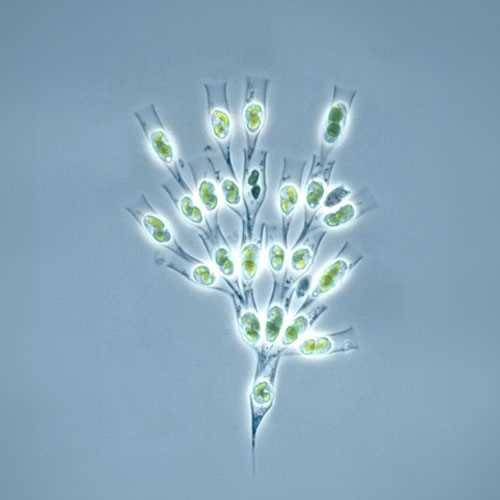
- Filter clogging (figure 1)
- Taste and odour production (figure 2)
- Increased cost of treatment processes
- Oxygen depletion
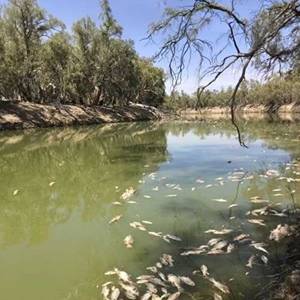
- Fish gill blockages (figure 3)
- Unsightly blooms (figure 4)
- Toxicity to humans and animals.
 |
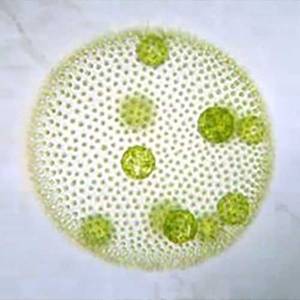 |
| Figure 1 Dinobryon – commonly associated with filter blockages | Figure 2. Volvox – commonly associated with taste and odour issues |
 |
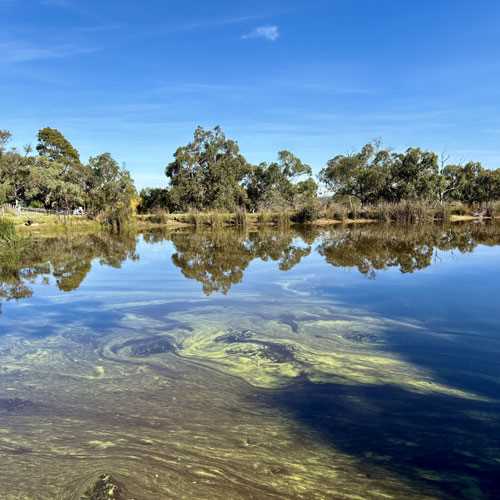 |
| Figure 3. Mass fish mortality | Figure 4. Microcystis bloom on farm dam |
Potentially toxic cyanobacteria
Cyanobacteria, commonly referred to as blue-green algae, are photosynthetic bacteria associated with a range of water quality implications, most notably the production of harmful toxins (table 1). These include hepatotoxins, neurotoxins, cytotoxins and dermatoxins. While the ability of a cyanobacterium to produce toxins is genetically determined, environmental conditions play a key role in influencing whether toxin production occurs.
Table 1. Examples of commonly occurring potentially toxic cyanobacteria
| Cyanobacteria | Toxin produced | Type of toxin | Target organ |
| Microcystis | Microcystins | Hepatotoxins | Liver, possible carcinogen |
| Nodularia spumigena | Nodularins | Hepatotoxins | Liver, possible carcinogen |
| Limnothrix/Geitlerinema | Unknown | Unknown | Brain, notochord, pancreas |
| Dolichospermum circinale | Saxitoxins
Anatoxin-a |
Neurotoxins, Hepatotoxins |
Nerve synapses, nerve axons |
| Raphidiopsis raciborskii
Raphidiopsis mediterranea Umezakia ovalisporum (Chrysosporum ovalisporum) |
Cylindrospermopsin, Deoxycylindrospermopsin | Cytotoxins | Liver, spleen, kidney, heart, lungs, stomach, adrenal glands, vascular and lymphatic system |
Risk assessment
To determine the risk associated with phytoplankton in a water body, the algae and cyanobacteria must be correctly identified. ALS, a global leader in environmental testing, operates NATA-accredited laboratories throughout Australia where phytoplankton identification and enumeration are undertaken. Highly trained and experienced analysts use high-power phase-contrast microscopy to examine samples. Reports will list taxa present, including cyanobacteria; identify potentially toxic types; and provide individual and total cells/mL results, as well as biovolume.
This information supports decisions around mandatory notifications, risk level and appropriate management actions. As illustrated by typical algal population growth dynamics, the most effective intervention occurs early, before exponential growth is established (figure 5). Routine monitoring is therefore critical for early bloom detection, enabling timely action before risks escalate and management becomes more difficult.
Where potential risk is identified, microscopic analysis is a fast and reliable method for determining the presence or absence of potentially toxic cyanobacteria in samples and assessing whether further testing is required. ALS provides NATA-accredited analyses for a range of algal toxins via LC-MS/MS, and for cyanobacteria toxin gene detection via qPCR (table 3).
Mandatory notification requirements
Under the Safe Drinking Water Act 2003, the Department of Health must be notified if drinking water does not comply, or is likely not to comply, with the standards. Notification is also required where water supplied, or intended to be supplied, for drinking purposes may pose a health risk or cause widespread consumer complaints.
The Australian Drinking Water Guidelines (ADWG) recommend risk‑based monitoring of source waters for cyanobacteria, informed by local conditions, bloom history and the potential presence of toxin‑producing species. Monitoring may include cyanobacterial cell counts, species identification, and where warranted, cyanotoxin analysis, with increased surveillance during periods favourable to bloom development.
The State of Victoria Department of Energy, Environment and Climate Action (DEECA) produce the Algal Management Framework: Victorian Blue-Green Algae Circular. This document provides comprehensive guidance on preparedness and response to harmful algal blooms and outlines clear mandatory notification requirements. These include notifying DEECA if the total biovolume of cyanobacteria in any water body are at or exceeding 0.2mm3/L. Additional trigger levels apply for drinking water, recreational water and seafood, requiring notification to the Department of Health and Human Services (DHHS).
There is an increasing shift toward the use of total cyanobacterial biovolume, rather than species-specific cell count thresholds, for bloom risk assessment. Biovolume accounts for differences in cell size and therefore provides a more representative measure of total algal biomass. It is calculated by identifying and counting the cells present, then applying their mean cell volume (table 2) to estimate the total cell volume in the sample (mm3/L).
Table 2. Examples of individual cyanobacteria taxa and their mean individual cell volume.
| Cyanobacteria | Mean individual cell volume (µm³) |
| Anathece | 2.1 |
| Cyanonephron | 5.4 |
| Pseudanabaena | 14 |
| Raphidiopsis raciborskii | 42 |
| Umezakia ovalisporum | 52 |
| Microcystis aeruginosa | 87 |
| Nodularia spumigena | 227 |
| Dolichospermum circinale | 250 |
Monitoring
Routine monitoring of phytoplankton supports effective water quality management by helping to:
- Meet regulatory and mandatory notification requirements
- Protect people, livestock and pets from exposure to cyanotoxins
- Provide a safe, high-quality drinking water supply
- Reduce the economic and ecological impact of algal blooms
- Identify water quality issues and emerging risks early
- Determine appropriate water treatment processes
- Evaluate the effectiveness of management interventions
- Ensure recycled water is safe for environmental release and commercial use, including irrigation of market gardens and recreational reserves
- Build historical datasets to track long‑term trends and predict future change
- Improve operational decision‑making and ecological understanding
- Identify potential causes and drivers of algal blooms.
How ALS can help
ALS provides a suite of expert services that can assist clients with monitoring algae and toxins (tables 3 and 4).
Table 3. Phytoplankton related analyses available at ALS (excluding Canberra):
| Cyanobacteria | Total algae | Algal toxins | Cyanobacterial genes | Chlorophyll | |
| Analytes | All cyanobacteria present | All microalgae and cyanobacteria present |
Microcystin-LR, RR, YR Nodularin, Cylindrospermopsin, Deoxycylindrospermopsin, Saxitoxin and analogues, Anatoxin-a |
16S rRNA
McyE/ndaF CryA SxtA |
Chlorophyll a Phaeophytin |
| Method | MB010.BGA MW024VCA | MB010
MW024VCA |
WP248
WP249 WP263 |
MM316 | MB003 |
| Analysis name | W-BGACNTBV | W-ALGCNTBV | W-MCYSTINL
W-ALG-NODL W-ALG-CYNL W-ALG-CYNL-EXT-INT W-ALG-SAX W-ALG-ANA |
W-CYAN-PCR | W-CHL-A |
| Instrumentation | Microscopy | Microscopy | LC-MS/MS | qPCR | Spectrophotometry |
| Units | Cells/mL
Biovolume mm3/L |
Cells/mL
Biovolume mm3/L |
µg/L | copies/mL | µg/L |
Table 4. Phytoplankton related analyses available at ALS Canberra:
| Cyanobacteria | Total algae | Chlorophyll | |
| Analytes | All cyanobacteria present | All microalgae and cyanobacteria present |
Low level Chlorophyll |
| Method | MW024.C
MW024.V |
MW024.T | EP008 / EP008B |
| Instrumentation | Microscopy | Microscopy | Fluorometry / Spectrophotometry |
| Units | Cells/mL Biovolume mm3/L | Cells/mL | µg/L |
References
National Medical Research Council, Australian Drinking Water Guidelines 6 2011, Version 4.0 Updated June 2025 – Microorganisms: Cyanobacteria and their toxins
National Medical Research Council, Guidelines for Managing Risks in Recreational Water (2008). Draft guidelines published January 2026.
State Government of Victoria (2025) Safe Drinking Water Regulations 2025. Statutory Rules 60/2025.
The State of Victoria Department of Energy, Environment and Climate Action (DEECA) produce the Algal Management Framework, Victorian Blue-Green Algae Circular (2023).