



























Flotation piloting

In order to satisfy rigorous due diligence requirements in the modern project development process, most flotation concentrator projects will need to undergo piloting to prove the process can run effectively in continuous/dynamic operation and meet the process design criteria (PDC) achieved on the bench. Considering continuous flows, recirculating streams, larger cells, industrial reagent grades, grinding and water chemistry, a successful bench regime will not automatically scale-up to a successful continuous circuit. It takes a specialist skill set to bring all of the technical and operational parameters together and ALS has that skill set along with a massive equipment inventory and decades of flotation piloting experience.
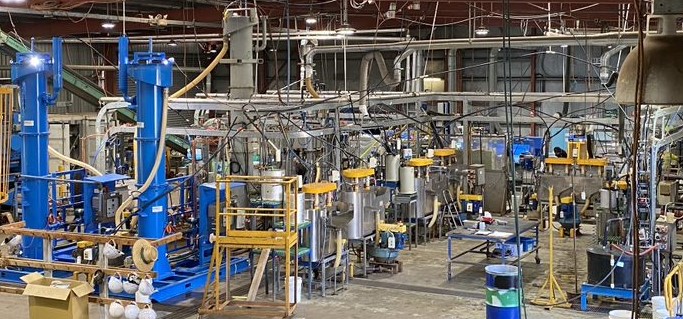
Fábrica piloto de flutuação

Flotation Piloting Services

Every bench scale flotation test regime and circuit can be completed at pilot scale with continuous operation. As mentioned above, and assuming the requisite technical acumen at ALS, the real test of successful flotation piloting is achieved by bringing together the following factors in one package:

  • Competent risk/hazard assessment and all aspects of health safety and environment (HSE). Considering the hazards of the ores and chemicals used in flotation, the risks to personnel and equipment can be significant. Even when the ores and chemicals are relatively benign, the generic safety hazards and risks with operating machinery and processing ores remain and must be thoroughly mitigated. With ever more stringent mandatory ESG guidelines enforced by government and industry regulatory authorities, clients require a service provider they can sign off on to safely conduct the rigors of piloting. With our commitment to HSE and quality, ALS is that service provider.
  • Correct Circuit Sizing: Before anything gets built, the flotation cells, pumps and pipework need to match and achieve the PDC, which will require the necessary experience to source and fabricate non-standard sizes via external suppliers.
  • Requisite Pilot Grinding Capability: To prepare the flotation feed stock at the correct PSD.
  • Flotation Cell Inventory: In order to accommodate a wide range of potential flotation circuits, ALS has the following cell inventory:
    • Conventional Agitair and Outokumpu trough cells: 24 free standing multi-cell flotation banks ranging from 0.5 to 300-litre cells are available to mix and match to suit a wide range of circuits and duties (i.e. rougher, cleaner and recleaner etc).
    • Column Cells: Via our strong alliance with Eriez, ALS can offer column flotation cells in 100 mm, 200 mm, 300 mm and 500 mm columns cells to incorporate into a pilot flotation circuit.
    Conditioning Tank Inventory: Reagent conditioning is a critical link in the flotation process, and unlike on the bench, we no longer have the luxury of using the huge mixing energies in the flotation cell to contact the slurry with the reagents. In the pilot circuit it means there must be separate conditioning tanks of the correct volume and type to achieve the conditioning PDC. ALS has a huge range of PVC custom baffled conditioning tanks with feed downcomers and exit launders. A large range of stands are also available to enable cascading tanks to utilise gravity flow ahead of the flotation cell banks. High Intensity Condition (HIC) tanks are also available for applications where the reagent needs physical force to ensure sufficient particle-chemical contact.
    • Reagent Mixing and Delivery: Reagent regimes can be multi-facetted and complex, with some reagents requiring pre-mixing, dilution and/or saponification. Once ready, precise delivery to the conditioning tanks or cells is required relative to the throughput. To achieve this, ALS employs over 60 highly accurate Masterflex peristatic pumps with a range of head sizes and tube diameters to meet all reagent delivery requirements.
    • Plant set-up and Construction Expertise. All of the above factors need to eventuate into a physical operating plant and the construction and set-up phase of a flotation pilot program is as important as the subsequent operation. One won’t happen without the other and ALS has the knowhow and experience to construct highly complex pilot plants.
    • Other Ancillary Infrastructure Support: Pilot plants require specific areas equipped with: service cable trays, water lines, compressed air; steam boilers and ring-mains to deliver heat to the cells; electronical process controllers for temperature, flow, and mass; chemical and reagent mixing and dosing; sample taking and monitoring equipment; gas manifolds and delivery systems; effluent and waste management; and dust and plant fume extraction and scrubbing where necessary. ALS has such fully dedicated areas set-up specifically for flotation piloting.
    • In-house assay facility. Pilot plants generate lots of samples that need quick processing and analyzing to deliver the data to enable plant control and decision making. There is no time to outsource these samples to an external laboratory. ALS has its own analytical facility on site in Balcatta to handle all pilot sampling requirements.


    Need more information or want to devise a specific flotation circuit?

    ALS can meet your needs.

    Please contact us for further details.

    Here are some frequently asked questions

    • How much mass does a typical flotation pilot program require?

      This cannot be answered accurately as every scope of work will be different and pilot plants can be scaled to a degree to comply with an available mass.

    • Does ALS run 24 flotation pilot operations?

      Yes. Fees and charges apply to cover addition costs and penalty rates. Available personnel may also be commensurate with the prevailing labour market conditions.

    • Will ALS hire out its flotation cells?

      Generally, no. We need our equipment at our labs and hire is not our core business.

    • Will ALS treat hazardous samples?

      Generally, yes. ALS has facilities and procedures to treat fibrous and radioactive samples. Surcharges do apply, however, to cover safety equipment, monitoring and decontamination.:

    • Our samples are from overseas, what do I do?

      ALS is a quarantine approved premises and treats many samples of oversea origin. Strict regulatory requirements are in needed around packaging and paperwork, however. ALS can advise you on these requirements.

    • Can I do my own testwork at ALS?

      Generally, no. Insurance and safety protocols typically prevent renting laboratory space, and this is not part of ALS’s business model. Clients are able to visit and witness testwork, but this is to observe only. Typically, clients may attend on 24/7 piloting campaigns and interact with senior staff members for technical and operational issues.

    • Can my associates and I view the testwork at ALS?

      Yes, clients are always welcome to visit our facilities and observe samples or tests in progress. Inductions are required and other rules may apply to visitors.

    • Will ALS dispatch my samples to third parties?

      Yes, if a testwork program is in progress, ALS will happily dispatch testwork products and feed samples to vendors, third party laboratories, and customers as required. Fees apply.

    • Does ALS do design engineering and consulting?

      No, as it is not our core business and would put us in direct competition with many of our clients. We can, however, put you in contact with a range of reputable engineering providers and consultants.

    Associated testwork services

    Related testwork

    Grinding always precedes flotation pilots followed by materials handling. Other areas may include:

    Click on the above links or contact us for further information. We can integrate a full program for you if required.