























SAG milling & grinding pilot plants

Fundamental step quite challenging at small scale

Most hard rock ore bodies will need a wet grinding stage during piloting to facilitate mineral liberation prior to downstream processing. As the required milling particle size distributions (PSDs) do not conveniently scale down to suit small scale processing, matching the mill size and type with the appropriate media charge to achieve the required mass throughput cannot be taken for granted in pilot plant operations. The same applies for the integrated mill product classification circuit (i.e. screening or hydro-cyclone). ALS has an extensive pilot grinding capability together with years of experience in operational techniques to bring the pilot milling circuit into equilibrium as soon as possible, thereby maximising precious sample mass for downstream operations.
SAG

Pilot grinding services

Every pilot plant project will have different requirements insofar as sample characteristics, throughput, and feed and product PSDs, which results in a different grinding circuit almost every time. Thus, achieving the correct pilot grinding solution requires a large equipment inventory together with a flexible approach and requisite expertise to build and operate the plant. The main factors involved are outlined below:

Grinding mills: There is no one size fits all when it comes to grinding and many different mills are required to achieve a range of applications. Broadly, ALS holds the following pilot mill types and sizes in inventory:

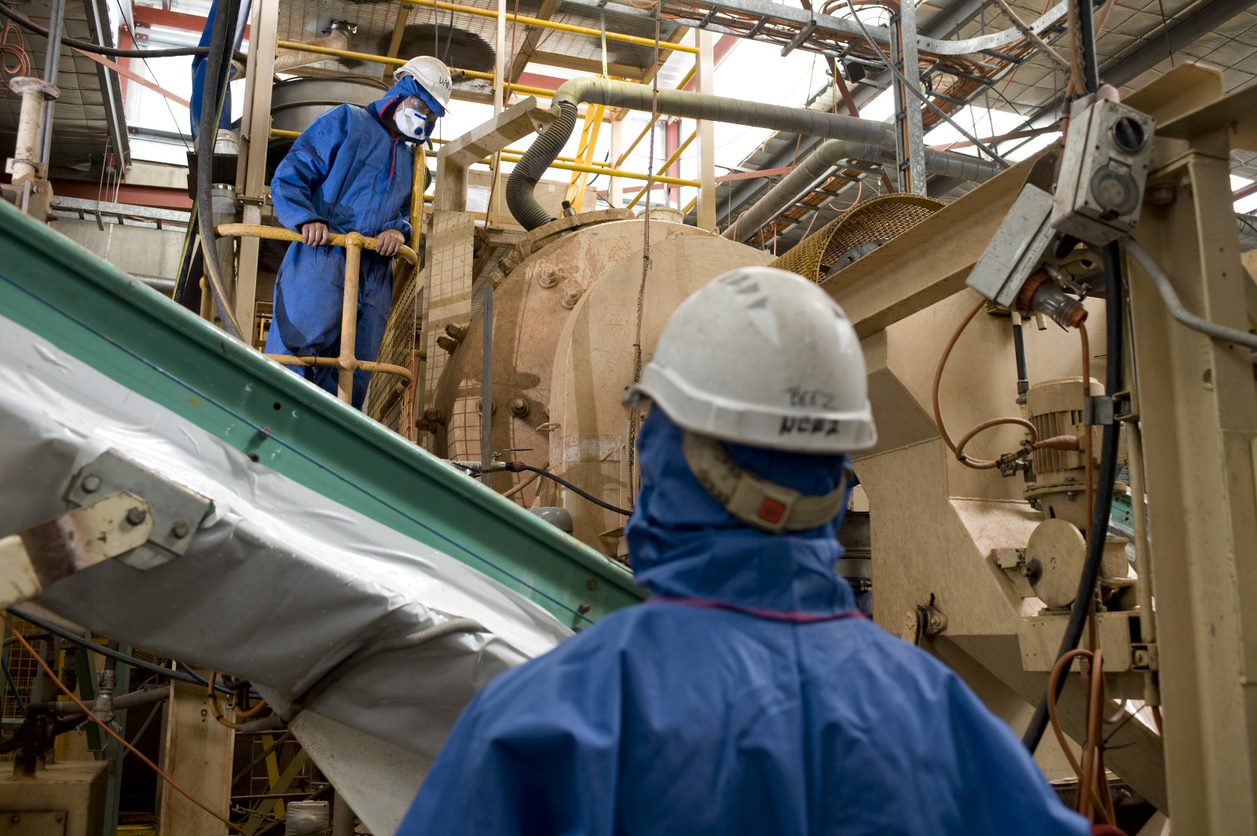
  • AG/SAG mill: One of the few remaining Hardinge 6’ x 2’ high aspect pilot 18 kW SAG mills in the world is fully operational at the ALS Metallurgy, Balcatta campus in Western Australia. Installed with a shell hatch to facilitate easy charge removal, the mill is installed on load cells connected to a SCADA system to collect mill weight, mill power, motor current, drive chain sprocket torque, and mill rotational speed (variable drive from 0% to 75 N c ). The mill is steel lined with a nominal 10 mm grate size with conventional hockey stick pulp lifters. Outer discharge grate panels can be installed to facilitate two or four x 75 mm ports pebble ports.

  • Integrated with a classification tower and feed/discharge conveyor system, the mill can be set-up to facilitate open circuit, single stage closed circuit, AG/SAG and ball mill circuit (SAB), and AG/SAG and ball mill circuit with recycle pebble crushing (SABC).

    The 450 mm feed chute takes full size ROM ore or feed stock can be artificially created from the appropriately sized drill core intervals. Throughputs are commensurate with ore competencies but typically range from 1 tph to 4 tph. Depending on ore competencies, stable-equilibrium operation durations can be usually achieved in 3 to 10 hours. Sample requirements thus range between 10t to 60t depending on the number of variables and circuits to be trialed.

  • Rod mills: Although rarely used in industrial practice, ALS has 2 x 2.3 kW rod mills for small (<50 kg/h) throughputs where preferential coarse grinding is advantageous for the downstream processing.

  • Ball mills: Ball mills are the stalwart unit of the majority of pilot grinding circuits. ALS has a range of rubber lined overflow ball mills including: 2.3kW, 4.4 kW high aspect (900 mm Dia x 400 mm EGL), 3 x units of 5.5 kW and 7.5 kW (900 mm Dia x 790 mm), 1 x 15 kW 900 mm Dia x 1800 mm EGL, 1 x 30 kW 1240 mm Dia x 1440 mm EGL). All of the above units can be operated in either primary or regrind grinding applications depending on the pilot design criteria. The larger units can also be matched with the SAG mill in SAB/SABC configuration.

  • Stirred mills (Regrinding). Finer regrinding or ultra-fine grinding is a frequent requirement in pilot plants and ALS has a range of units that can run continuously in pilot applications. The following mills are located at Balcatta: ISAMill tm , Deswik, and Metprotech as well as some non-branded stirred mills. The IOTC in Wangara also houses the pilot Outotec HIG (High Intensity Grinding) Mill and two Nippon-Eirich Stirred Tower Mills (a large continuous mill and a batch unit). All of the above can be operated independently, and all but one seamlessly integrated into a continuous pilot plant circuit.

Feed arrangements & slurry handling: No mill can operate without the appropriate before and after materials handling arrangements. ALS has a range of different sized feed hoppers and belt/screw feeders to match the mill size. Similarly, a range of slurry pumps in various sizes is available to handle mill slurry product including: Open bowl Sala and Metso pumps, Warman AH Slurry pumps, Bredle peristaltic hose pumps and Sandpiper peristaltic diaphragm pumps. In combination, the above equipment can meet most grinding solutions.

Classification systems: Closed circuit classification to emulate industrial scale practice is imperative for pilot scale operations. Typically, this falls into two main categories:

  • Vibrating screens: Despite producing a truncated PSD, vibrating screens are quite adequate mill product classifiers in most-small scale pilot circuits. The go to unit for ALS is the circular Kason screen, which is available in multiple diameters and can run either a single or multi-deck configuration with interchangeable screen aperture sizes. Gravity is an important factor in pilot plant set-up and ALS has a range of stands and infrastructure available to position the screens in close proximity to the mill to take advantage of gravitational flow.

  • Hydro-cyclone circuits: Unfortunately, hydro-cyclones are not scalable for lower throughput (i.e. a small diameter hydro-cyclone cannot be matched to a small flowrate unless the PSD is very fine). The cyclone size is entirely predicated on the product PSD and cut size. This often results in an entirely mismatched mill feed rate versus cyclone feed rate (e.g. a P 80 150 µm COF product requires a 100 mm hydro-cyclone that needs ~1 tph or ~4 m 3 /h, which is completely mismatched to a 250 kg/h mill feed). This is why vibrating screens are often the most practical solution for pilot grinding circuits. However, there are circumstances where a hydro-cyclone can be employed whereby it is run in a closed loop at the appropriate flowrate and pressure, with auto-controlled slurry splitters set-up to cut the appropriate volume from the overflow and underflow streams.

Need more information or want to devise a specific grinding circuit?

ALS can meet your needs and can also leverage off vendors for specific or non-conventional equipment items.

Please contact us for further details.

Here are some frequently asked questions

  • What is your pilot grinding throughput range?

    We can build bespoke circuits to handle between 30 kg/h up to 4 tph. The maximum feed rate is not so much the mill rather than the limitations of downstream materials handling (i.e. thickening and filtering).

  • Can we supply our own grinding media?

    Yes, ALS has a large grinding media inventory, but clients are welcome to source their own supplies and have it delivered to the laboratory.

  • How long does it take to get the mill into equilibrium?

    As little as 3 hours operation in most cases, but challenging circumstances often arise which may take longer.

  • Will ALS do toll grinding services?

    Tentatively yes, depending on the scope of work. Contact us to discuss.

  • Will ALS hire out its mills?

    Generally, no. We need our mills at our labs and hire is not our core business.

  • Does ALS do hydro-cyclone testing?

    Yes, but caveats apply. Batch hydro-cyclone testwork comes with many challenges not seen in continuous industrial plants. This is mainly concerned with settling and particle stratification in the feed tank, which can skew PSD results. Contact us to discuss.

  • Does ALS have a Derrick screen?

    No, but hire units are available.

  • Will ALS treat hazardous samples?

    Generally, yes. ALS has facilities and procedures to treat fibrous and radioactive samples. Surcharges do apply, however, to cover safety equipment, monitoring and decontamination.

  • Our samples are from overseas, what do I do?

    ALS is a quarantine approved premises and treats many samples of oversea origin. Strict regulatory requirements are in needed around packaging and paperwork, however. ALS can advise you on these requirements.

  • Can I do my own testwork at ALS?

    Generally, no. Insurance and safety protocols typically prevent renting laboratory space and this is not part of ALS’s business model. Clients are able to visit and witness testwork but this is to observe only. Typically, clients may attend on 24/7 piloting campaigns and interact with senior staff members for technical and operational issues.

  • Can my associates and I view the testwork at ALS?

    Yes, clients are always welcome to visit our facilities and observe samples or tests in progress. Inductions are required and other rules may apply to visitors.

  • Will ALS dispatch my samples to third parties?

    Yes, if a testwork program is in progress, ALS will happily dispatch testwork products and feed samples to vendors, third party laboratories, and customers as required. Fees apply.

  • Does ALS do design engineering and consulting?

    No, as it is not our core business and would put us in direct competition with many of our clients. We can, however, put you in contact with a range of reputable engineering providers and consultants.

Associated testwork services

Related testwork

Grinding always precedes other processes, both at bench scale and pilot scale that may include:

Click on the above links or contact us for further information. We can integrate a full program for you if required.