






























Imperative to do it right from the start

As with sample preparation on small parcels of ore for bench scale test work, bulk sample preparation of parcels in the realms of many tonnes to hundreds of tonnes needs to be done correctly to avoid compromising the entire downstream testwork program. Larger sample parcels, however, present a different set of challenges and require a larger range of equipment with the procedures to suit. ALS takes great pride in its bulk sample preparation capability in line with our ISO 9001 quality accreditation. We have tackled almost every conceivable preparation and blending scenario in our long history, so clients can be confident their testwork will get off to a good start.
Esmagamento a granel

Bulk sample preparation services

Bulk sample preparation essentially comes down to crushing and screening to a target crush size (in mm), followed by blending. However, when considering sample representivity and achieving high degrees of heterogeneity in the ore parcels, there can be a lot more than meets the eye at first. Especially in comparison to small parcel preparation, or conversely, industrial preparation on mine sites.

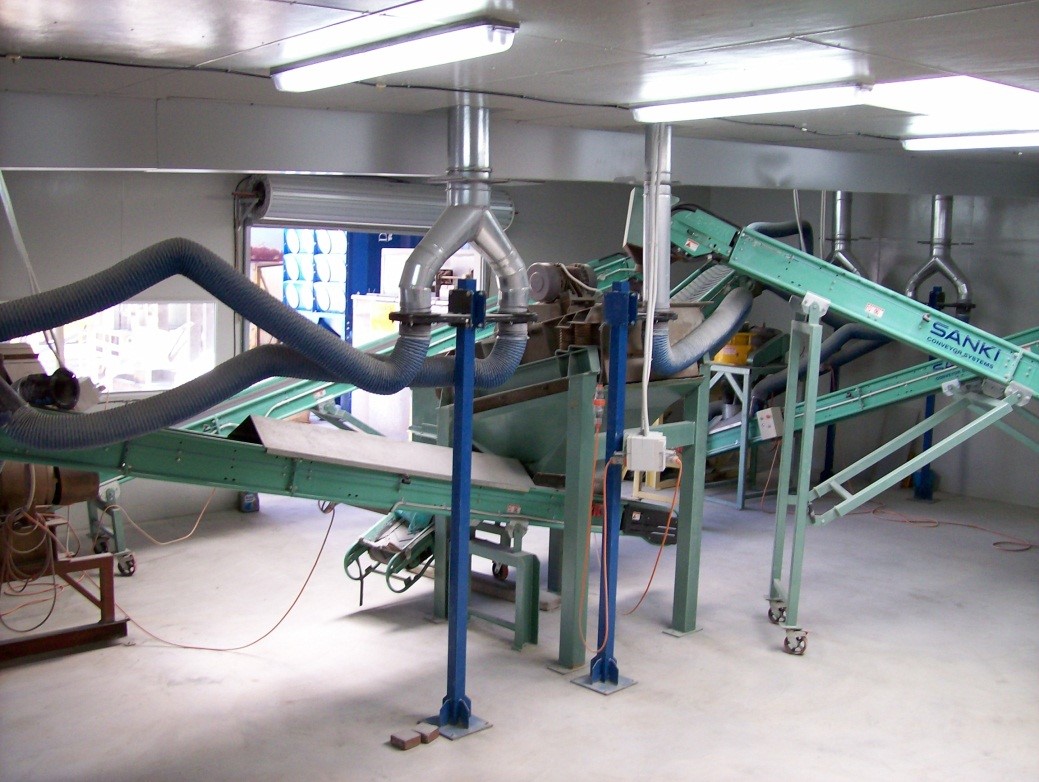
In terms of crushing and screening, ALS has a dedicated bulk crushing room centered around a double decked 1m x 2m vibrating screen whereby the screen mesh aperture panels can be changed to suit the target crush size. Product from the screen gravitates onto a conveyor to discharge into an adjacent blending room. Every crushing circuit is different commensurate with the ore, and as such, crushing circuits are arranged around the vibrating screen using a series of mobile crushers (Jaw, Cone and Rolls) of various sizes, with materials transport facilitated by mobile Sanki conveyors of various dimensions and belt types (smooth and chevron).

Crushing and Screening: The material type, characteristics and mass will predicate the circuit set-up, as follows:

  • Material Type: Typically, we receive combinations of ROM (Run of Mine) ore, diamond drill core (i.e. PQ, HQ, NQ, Cauldwell and sometimes 150 mm Bauer Drill Core), and RC drill chips. Our preferred packaging is in 1 tonne bulka bags and/or 200L drums.

  • Mass and throughput: Small masses will require smaller crushers and may incorporate some manual handling stages (i.e. via buckets) for small sample flows. Large masses can facilitate high throughputs via large crushers and conveyors.

  • Particle Size Distribution (PSD): Maximum particle size for our crushers is 200 mm and any particles larger than this may need to be broken and handled by hand. For very large ROM parcels (e.g. for SAG Milling Pilots) a rotary 200mm & 100 mm trommel is available for screening.

  • Hardness and competency: Hard ores may reduce throughput but screen relatively easily and soft ores will crush very quickly but screening can be limited due to open area restrictions.

  • Moisture Content: Moisture is rarely a problem for processing of competent ores, however, high moisture bearing clays, such as laterites, can stop a crushing circuit dead in its tracks. These types of “sticky” ores need a different approach (described below).

  • Blending and Splitting: The material mass, PSD and moisture content usually determine the blending (homogenization) and splitting methodology, together with the client sub-sampling scope of work, as follows:

  • Small Parcels of Competent Ore, <2t, P 100 <40 mm: These masses are usually first iteratively blended in 200L drums via a 40mm riffle splitter. Splitting of bench scale or head sample charges is conducted by taking 1x200L drum and passing through an 18 segment rotary sample divider (RSD).

  • Parcels of Competent Ore, <5t: For these mid-sized masses, crushed product is immediately passed through a 12 Drum Rotary Splitter, which is essentially a rotating chute that distributes the flowing conveyor discharge around a circle of 12 x 200L drums. Additional blending, if deemed necessary, is done via a series of riffle splitter passes. Alternatively, selected rotary blended drums can proceed directly to the 18 x segment RSD for splitting of bench scale or head sample charges.

  • Parcels of Competent Ore, >5t: For these larger masses, the crusher circuit product is formed into a conical stockpile under the conveyor discharge. The stockpile is then blended via a skid steer loader (Bobcat) via modified version of the cone and quarter method. Sample is then placed into either 200L drums or bulka bags. Once again if addition blending is deemed necessary, a series of riffle splitter passes can be conducted. Alternatively, selected bobcat blended drums can proceed directly to the 18 x segment RSD for splitting of bench scale or head sample charges.

  • Parcels of “Sticky” High Moisture Ore: Large or small masses, this type of material is by far the most challenging. Moist clays are sticky and will not flow like dry particulate distributions. Neither will the plastic characteristics of agglomerates crush like regular rocks. Very often clays have very little coarse material content and some partial air drying (sufficient to promote some flow characteristics without destroying the water of crystallisation in the silicates) can allow the material to proceed to cone and quartering, or Bobcat blending to produce a suitable mill or scrubber feed. Ore types containing a bimodal component of competent rocks can undergo screening via a Bobcat grizzly bucket to separate out the rocks for crushing, which can then be integrated into the cone and quartering, or Bobcat blending procedure.

Need more information or want to devise a specific bulk preparation program?

ALS has access to a full range of equipment and can also leverage of vendors for larger scale testwork.


No problem. Please contact us for further details.

Frequently asked questions

Associated testwork services

Related testwork

Bulk sample preparation always precedes other processes, both at bench scale and pilot scale that may include:

Click on the above links or contact us for further information. We can integrate a full program for you if required.