



























 Search
 English



























 Login
Login


EnviroMail™ 162 Australia
RT‑qPCR for rapid E. coli detection in water enabling four‑hour negative reporting

Announcing the introduction of Method MM336, a cutting-edge approach for the rapid detection and enumeration of E. coli in water using RT-qPCR technology. This innovative method helps significantly reduce traditional E. coli testing turnaround times – from a full day to just a few hours – enabling faster responses during contamination events. By helping minimise service disruptions, Method MM336 can enhance operational resilience and support water utilities in delivering safe, reliable water services with confidence.
PCR in modern water monitoring
Within this framework, organism‑specific methods have been developed to support targeted monitoring applications. Early regulatory uptake in the United States focused on qPCR-based detection of Enterococci through EPA Methods 1611 and 1609, establishing validated workflows and quality criteria for routine use. Internationally, standards such as ISO/TS 12869:2019 define performance requirements for Legionella, further embedding PCR within established water quality monitoring programs. More recently, EPA Draft Method C has extended these approaches to E. coli, applying similar principles of quality assurance and validation to support rapid detection.
The application of these methods has demonstrated clear operational benefits. In the United States, Draft Method C has enabled same‑day quantification of E. coli at over 100 recreational sites, supporting faster public health responses and improved operational decision‑making (Haugland et al. 2021). Similarly, multi‑country validation under the EU Bathing Water Directive confirmed that real‑time PCR can reduce detection times from one to two days to a few hours while meeting ISO validation requirements (Gomez Cortes et al. 2024; Gomez et al. 2025). Method MM336 is based on EPA Draft Method C, providing a validated framework tailored to local monitoring requirements in Australia.
Adapting to change in regulation
In Victoria, routine potable water monitoring for Escherichia coli (E. coli) is essential to verify that preventive measures such as disinfection and filtration are functioning effectively. Under the Safe Drinking Water Regulations (SDWR) and Australian Drinking Water Guidelines (ADWG), E. coli must not be detected in any 100 mL sample of drinking water (NHMRC & NRMMC 2011; NHMRC 2011). Any detection requires immediate investigation and corrective action.
Traditionally, compliance relies on culture-based methods, which typically take 18–27 hours to deliver results (figure2). While suitable for routine monitoring, this timeframe is inadequate during contamination events when rapid decision-making is critical. The need for rapid results has grown significantly since false-positive allowances were removed under the SDWR, meaning any E. coli detection is now treated as a regulatory breach.
A rapid, sensitive molecular workflow
Method MM336 reduces turnaround time to approximately 4 hours, enabling faster public health responses during contamination events and helping minimise operational risk.
Together, these markers provide complementary strengths, forming the basis of a dual-target strategy that helps reduce false negatives and build confidence in results. This approach is integrated into a PCR workflow aligned with international best-practice principles for molecular water testing, helping ensure reliable detection across diverse water matrices.
Key benefits offered
- Rapid confirmation of results to inform mobilisation requirements
- Fast response during contamination investigations and incidents
- Reduced costly delays and improved public health protection
- Fast reporting to the Victorian Department of Health.
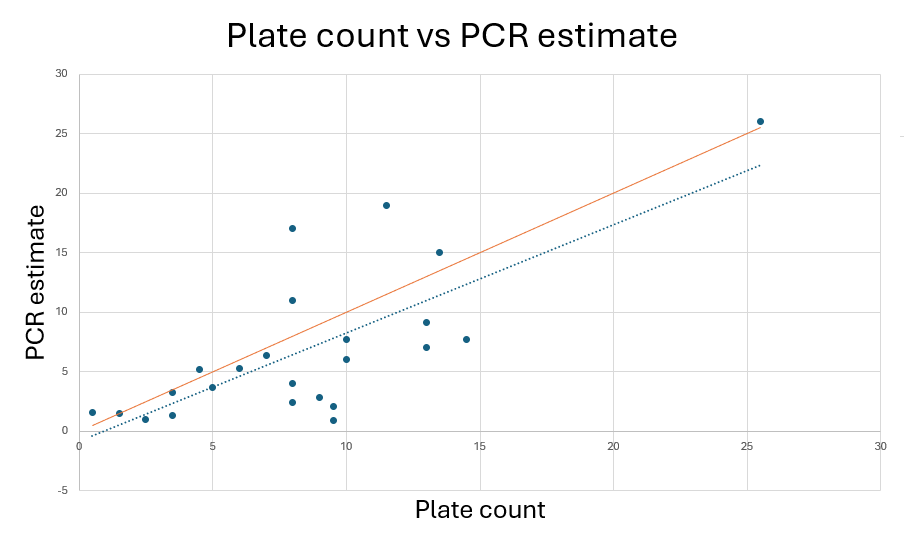
Figure 1. Correlation between plate counts and PCR estimates for E. coli in spiked samples.
Specifications
Table 1. Method specifications
| Method code | MM336 |
| Analytes | Potable and other water matrices |
| Sample volume | 1 L minimum |
| Holding time | 26 hours |
| Turnaround time | ~4 hours |
| Limit of reporting | Estimated cfu/100 mL |
| Reporting format | Qualitative and quantitative |
Verification outcomes
Comprehensive verification studies have shown that Method MM336 delivers high sensitivity, strong specificity, and consistent reliability in potable water.
These findings support the use of the method alongside culture-based enumeration for E. coli monitoring.
Sensitivity and specificity
PCR results demonstrated strong concordance with plate culture, with sensitivity and specificity both exceeding 95% (table 2), meeting internationally recognised performance criteria for qPCR. Estimated counts from PCR showed a strong and statistically significant correlation with plate culture counts in spiked samples (Pearson’s r = 0.744; figure 1), indicating that the method can provide meaningful estimates of colony forming units (cfu), in addition to detecting E. coli contamination. The method achieved 100% negative predictive value, supporting a high level of confidence in negative results.
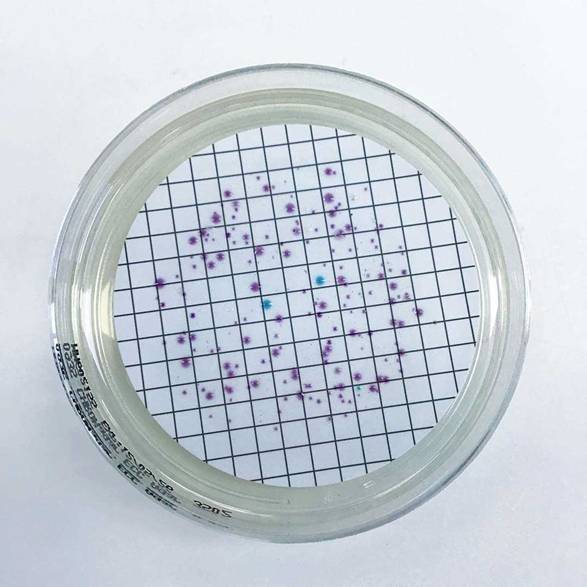
Figure 2. Colony development on chromogenic agar after 18–24 hours incubation. Putative E. coli (blue), coliform (purple) and non-coliform colonies (cream) are visible.
Table 2. Sensitivity and specificity of method MM336 (PCR), calculated against method MM698 (culture), for 44 potable water samples (positives spiked).
| Metric | Sample type (n) | Concordance | 95% CI | Counts (Tp/FN/FP/TN) |
| Sensitivity | Culture positive (24) | 100% | 85.8%-100% | 24/0/-/- |
| Specificity | Culture negative (20) | 95%* | 75.1%-99.9% | -/-/1/19* |
*PCR detects VBNC cells and offers a lower detection limit, enabling identification of contamination that culture may miss. WhilePCR can theoretically amplify DNA from non-viable cells, performance metrics meet internationally recognised benchmarks for qPCR.
TP = true positive; FN = false negative; FP = false positive; TN = true negative. Note: Results (TP/FN/FP/TN) are defined relative to the MM698 (culture) method and do not represent absolute presence or absence of E. coli.
While PCR specificity was slightly below 100% (table 2), culture-based methods detect only cells capable of growth under laboratory conditions. They may miss viable but non-culturable (VBNC) cells or trace contamination, both of which PCR can identify owing to its direct targeting of DNA.
Although PCR can theoretically amplify DNA from non-viable cells, the strong correlation between PCR and culture counts across spiked samples indicates that interference from extraneous DNA is negligible and does not compromise quantitation. These findings underscore PCR’s reliability as a rapid, sensitive alternative to culture for potable water monitoring.
Reliability in potable water
Performance was assessed exclusively in potable water samples, with only trace amounts of effluent used as a spike source. Results confirmed consistent amplification efficiency and reproducibility, with replicate analyses showing <5% coefficient of variation (CV).
No significant matrix interference was observed.
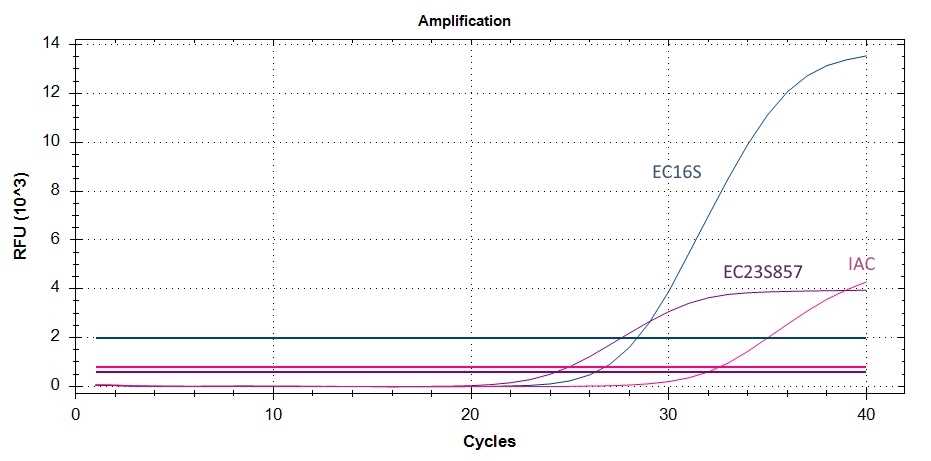
Figure 3. Amplification plot for E. coli PCR assay targets: EC23S857, EC16S and IAC.
Procedure
Sample concentration
Potable water samples are collected in sterile bottles dosed with sodium thiosulfate, stored at 5 ± 3 °C, and processed within a maximum of 26 hours. A 1 L sample is concentrated by vacuum filtration through a 0.45 μm membrane using aseptic technique.
The membrane is transferred to a bead tube for nucleic acid extraction. Each batch includes a process blank and positive to help verify workflow performance.
Nucleic acid purification and PCR
Total nucleic acid is extracted using the MagMAX™ CORE kit with bead-beating on an automated platform. Extracted eluate is used in a duplex RT-qPCR assay with an internal amplification control (IAC) included to monitor inhibition. Each PCR batch includes standards and a no-template control to ensure quality. A positive detection in the amplification plot (figure 3) is quantified from the standard curve in gene copies per reaction.
Result analysis and reporting
Estimated cfu per 100 mL is calculated from gene copies per reaction using a validated copies-to-cfu conversion factor and sample volume. Results are reported as detected/not detected, alongside quantitative estimates. The method achieves sensitivity consistent with ADWG requirements (1 cfu/100 mL) as outlined by NHMRC and NMMRC (2011).
Regulatory context
The method was developed to meet ADWG requirements for E. coli detection, helping ensure sensitivity consistent with potable water safety standards.
The workflow and verification process are NATA accredited for potable water testing, reinforcing ALS’ commitment to accredited, high-quality analytical services.
Key compliance features include:
- Dual-marker design for enhanced inclusivity and sensitivity
- Rigorous QA measures including multi-level process controls and internal controls for robust confidence in results.
- NATA accreditation.
- Quantitative reporting with strong correlation to cfu using experimentally verified conversion factors.
Special requirements
Method request
When submitting samples, clearly indicate method code MM336 on the chain of custody. Include any priority turnaround or out-of-hours requirements to ensure correct processing.
Sample submission
Samples are to be received by the ALS Scoresby lab within 20 hours of collection.
For same-day reporting, samples must be received by the ALS Scoresby lab by 6 pm.
ALS can supply a 2L sterile bottle for sample collection.
Parallel analysis
This PCR method is performed in parallel with the standard plate culture method (MM698).
Clients should collect sufficient sample volume to allow both analyses to be completed without compromise.
Out-of-hours reporting
For urgent or time-sensitive results, ALS offers reporting outside standard business hours. To avoid delays, clients must nominate a dedicated contact person on the CoC who will be available to receive data and respond promptly. Out-of-hours rates apply.
Given the critical nature of this method, we recommend contacting ALS’ Client Services team by phone immediately after sample dispatch, so appropriate measures can be put in place and all arrangements confirmed.
References
Gomez Cortes L, Gomez L, Cortes A, Garcia-Aljaro C, Blanch AR (2024) The European trial exercise on Escherichia coli detection in bathing waters. Publications Office of the European Union. doi:10.2760/42220.
Gomez L, Cortes A, Garcia-Aljaro C, Blanch AR (2025) Application of a real-time reverse transcription polymerase chain reaction for rapid detection of Escherichia coli in drinking water: an EU representative study. Environ. Res., 279, 121786.
Haugland R, Aw TG, Briggs S, Dreelin E, Aslan A, Dorevitch S, Shrestha A, Isaacs N, Kinzelman J, Kleinheinz G, Noble R, Rediske R, Scull B, Rosenberg S, Weberman B, Sivy T, Southwell B, Siefring S, Oshima K, Haugland R (2021) Large-scale comparison of E. coli levels determined by culture and a qPCR method (EPA Draft Method C) in Michigan towards the implementation of rapid multi-site beach testing. J. Microbiol. Methods 184 106186. doi:10.1016/j.mimet.2021.106186.
P.H.M. (2002) Quantification of bacteria adherent to gastrointestinal mucosa by real-time PCR. J. Clin. Microbiol., 40(12), 4423–4427. doi:10.1128/JCM.40.12.4423-4427.2002.Sivaganesan, M., Aw, T.G., Briggs, S., Dreelin, E., Aslan, A., Dorevitch, S., Shrestha, A., Isaacs, N., Kinzelman, J., Kleinheinz, G., Noble, R., Rediske, R., Scull, B., Rosenberg, S., Weberman, B., Sivy, T., Southwell, B., Siefring, S., Oshima, K. and Haugland, R. (2019) Standardized data quality acceptance criteria for a rapid Escherichia coli qPCR method (Draft Method C) for water quality monitoring at recreational beaches. Water Res., 156, 456–
464. doi:10.1016/j.watres.2019.03.011.
U.S. Environmental Protection Agency (2013) Method 1609: Enterococci in Water by TaqMan® quantitative polymerase chain reaction (qPCR) with internal amplification control (IAC) assay. EPA-820-R-13-005. Washington, D.C.: US EPA Office of Water.
U.S. Environmental Protection Agency (2012) Method 1611: Enterococci in Water by TaqMan® quantitative polymerase chain reaction (qPCR) assay. EPA-821-R-12-008. Washington, D.C.: US EPA Office of Water.
NHMRC and NRMMC (2011) Australian Drinking Water Guidelines Paper 6 National Water Quality Management Strategy. National Health and Medical Research Council, National Resource Management Ministerial Council, Commonwealth of Australia, Canberra. ISBN 1864965118.National Health and Medical Research Council (2011) Escherichia coli | Australian Drinking Water Guidelines Part 5: Microorganisms. National Health and Medical Research Council, Canberra. Available at: https://guidelines.nhmrc.gov.au/australian-drinking-water-guidelines/part-5/microorganisms/microbial-indicators/escherichia-coli (Accessed: 12 December 2025).
State Government of Victoria (2025) Safe Drinking Water Regulations 2025. Statutory Rules 60/2025. Melbourne: State Government of Victoria. Available at: https://www.legislation.vic.gov.au/as-made/statutory-rules/safe-drinking-water-regulations-2025 (Accessed: 12 December 2025).