Ensuring High-Grade Mānuka Honey
Dihydroxyacetone (DHA), the precursor to methylglyoxal (MG) in honey, is produced in the nectar of mānuka flowers. The concentration of DHA in nectar varies between trees.
ALS Solutions provides you with online access to your sample and analytical information from anywhere.
Login

Retrieve results and track sample progress in real time with access to featured digital products such as CoreViewer™ and ALS QCPro™.
Login

This convenient application lets customers closely track oil analysis reports in process in real time.
LoginDihydroxyacetone (DHA), the precursor to methylglyoxal (MG) in honey, is produced in the nectar of mānuka flowers. The concentration of DHA in nectar varies between trees.


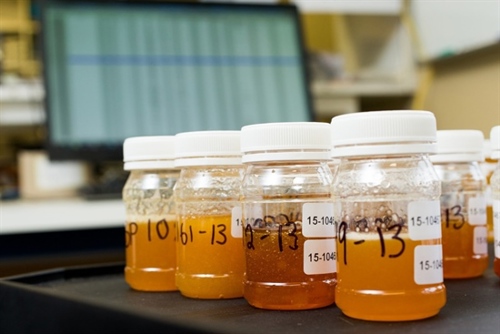
ALS NZ’s nectar test measures DHA and the main sugars (fructose and glucose) in nectar samples. Customers receive a report with concentrations of DHA and sugar in their sample. DHA results are also converted to mg/800g of sugar to rank the DHA concentrations found in different samples, at a sugar level that roughly matches that found in honey. However, while the results can be used for ranking samples, for a range of reasons the actual concentration of DHA in honey from an area may not be the same as that found in the nectar from the same area.
Read our beekeeper magazine article on nectar testing.
This test is for the nectar of mānuka plants. There are a variety of different methods for sampling nectar to suit the customer’s needs; nectar can be taken directly from the flower or flowers can be soaked in water to extract the nectar.
Read our guide to nectar sampling.
ALS can send out a sampling kit depending on the method chosen for nectar collection. The cost of a basic sampling kit is included in the price of the test.
Nectar samples are diluted and derivatised before being analysed for DHA and sugar by Ultra Performance Liquid Chromatography (UPLC) with UV detection.
This method is not currently an IANZ accredited test. However it is based on the IANZ accredited Mānuka 3-in-1 test, and has been developed and validated using ALS NZ’s normal criteria as an ISO 17025 accredited laboratory.
Please contact us for current pricing and TAT's.